
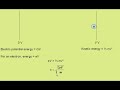
Electron Behavior and Energy Calculations

Interactive Video
•
Physics
•
11th - 12th Grade
•
Practice Problem
•
Hard

Patricia Brown
FREE Resource
Read more
10 questions
Show all answers
1.
MULTIPLE CHOICE QUESTION
30 sec • 1 pt
What happens to an electron when it is placed between two metal plates with a potential difference?
It moves towards the positive plate.
It remains stationary.
It oscillates between the plates.
It moves towards the negative plate.
2.
MULTIPLE CHOICE QUESTION
30 sec • 1 pt
What is the formula for electrical potential energy?
Q/M
1/2 MV^2
MV^2
QV
3.
MULTIPLE CHOICE QUESTION
30 sec • 1 pt
What symbol is used to represent the charge of an electron?
V
e
E
Q
4.
MULTIPLE CHOICE QUESTION
30 sec • 1 pt
What happens to the potential energy of an electron as it moves towards the positive plate?
It decreases.
It becomes zero.
It remains constant.
It increases.
5.
MULTIPLE CHOICE QUESTION
30 sec • 1 pt
What is the relationship between potential energy and kinetic energy at the point just before the electron reaches the positive plate?
Potential energy is less than kinetic energy.
Potential energy is greater than kinetic energy.
Potential energy is zero.
Potential energy is equal to kinetic energy.
6.
MULTIPLE CHOICE QUESTION
30 sec • 1 pt
How is the speed of an electron calculated when it is accelerated through a potential difference?
Using the formula V = IR
Using the formula E = MC^2
Using the formula v = sqrt(2eV/m)
Using the formula F = ma
7.
MULTIPLE CHOICE QUESTION
30 sec • 1 pt
What is the potential difference used in the example calculation?
2000 volts
10000 volts
5000 volts
1000 volts
Access all questions and much more by creating a free account
Create resources
Host any resource
Get auto-graded reports

Continue with Google

Continue with Email

Continue with Classlink

Continue with Clever
or continue with

Microsoft
%20(1).png)
Apple

Others
Already have an account?

