
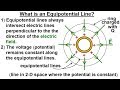
Understanding Equipotential Lines and Electric Fields

Interactive Video
•
Physics
•
9th - 10th Grade
•
Practice Problem
•
Hard

Patricia Brown
FREE Resource
Read more
10 questions
Show all answers
1.
MULTIPLE CHOICE QUESTION
30 sec • 1 pt
What does the term 'equipotential' imply in the context of electric fields?
Decreasing voltage
Constant voltage
Changing voltage
Increasing voltage
2.
MULTIPLE CHOICE QUESTION
30 sec • 1 pt
In a two-dimensional plane with a charged ring, how is the charge distributed?
Equally
Randomly
Concentrated at one point
Unequally
3.
MULTIPLE CHOICE QUESTION
30 sec • 1 pt
What is the relationship between equipotential lines and electric field lines?
They are parallel
They never intersect
They intersect at random angles
They are perpendicular
4.
MULTIPLE CHOICE QUESTION
30 sec • 1 pt
What remains constant along an equipotential line?
Electric field strength
Voltage
Magnetic field
Current
5.
MULTIPLE CHOICE QUESTION
30 sec • 1 pt
How do equipotential lines behave in relation to electric field lines?
They are always perpendicular to electric field lines
They never intersect electric field lines
They intersect electric field lines at acute angles
They run parallel to electric field lines
6.
MULTIPLE CHOICE QUESTION
30 sec • 1 pt
What happens to the voltage when moving along an equipotential line?
It remains constant
It fluctuates
It decreases
It increases
7.
MULTIPLE CHOICE QUESTION
30 sec • 1 pt
What is the significance of the perpendicular intersection of equipotential lines with electric field lines?
It marks the end of the electric field
It shows the direction of current
It signifies constant voltage
It indicates a change in voltage
Access all questions and much more by creating a free account
Create resources
Host any resource
Get auto-graded reports

Continue with Google

Continue with Email

Continue with Classlink

Continue with Clever
or continue with

Microsoft
%20(1).png)
Apple

Others
Already have an account?


