
Understanding Forces and Friction

Interactive Video
•
Physics
•
9th - 10th Grade
•
Practice Problem
•
Hard

Patricia Brown
FREE Resource
Read more
10 questions
Show all answers
1.
MULTIPLE CHOICE QUESTION
30 sec • 1 pt
What is the main difference between static and kinetic friction?
Static friction occurs when an object is moving, while kinetic friction occurs when it is stationary.
Static friction is always greater than kinetic friction.
Kinetic friction is dependent on the speed of the object.
Static friction is less than kinetic friction.
2.
MULTIPLE CHOICE QUESTION
30 sec • 1 pt
Which factor does NOT affect the amount of friction between two surfaces?
Material of the surfaces
Normal force
Color of the surfaces
Surface roughness
3.
MULTIPLE CHOICE QUESTION
30 sec • 1 pt
What does the coefficient of friction (mu) represent?
The weight of the object
The angle of the surface
A ratio with no units
The speed of the object
4.
MULTIPLE CHOICE QUESTION
30 sec • 1 pt
In the formula for friction, what is the unit of force of friction?
Newtons
Meters
Joules
Kilograms
5.
MULTIPLE CHOICE QUESTION
30 sec • 1 pt
How is the normal force calculated when there is no angle involved?
It is equal to the mass of the object.
It is equal to the weight of the object.
It is equal to the height of the object.
It is equal to the speed of the object.
6.
MULTIPLE CHOICE QUESTION
30 sec • 1 pt
What is the minimum force required to move a 135 kg refrigerator box with a static friction coefficient of 0.47?
800 Newtons
500 Newtons
621.81 Newtons
700 Newtons
7.
MULTIPLE CHOICE QUESTION
30 sec • 1 pt
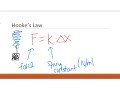
What does Hooke's Law state about the force on a spring?
Force is equal to the speed of the object.
Force is equal to mass times acceleration.
Force is equal to the spring constant times the stretch of the spring.
Force is equal to the weight of the object.
Access all questions and much more by creating a free account
Create resources
Host any resource
Get auto-graded reports

Continue with Google

Continue with Email

Continue with Classlink

Continue with Clever
or continue with

Microsoft
%20(1).png)
Apple

Others
Already have an account?


