
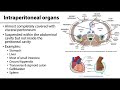
Retroperitoneal and Intraperitoneal Organs

Interactive Video
•
Biology
•
11th - 12th Grade
•
Practice Problem
•
Hard

Patricia Brown
FREE Resource
Read more
10 questions
Show all answers
1.
MULTIPLE CHOICE QUESTION
30 sec • 1 pt
What is the primary focus of this video tutorial?
Defining terms related to gastrointestinal anatomy
Explaining cardiovascular anatomy
Discussing respiratory system functions
Analyzing muscular system dynamics
2.
MULTIPLE CHOICE QUESTION
30 sec • 1 pt
Which of the following is an example of an intraperitoneal organ?
Kidney
Liver
Ureter
Inferior vena cava
3.
MULTIPLE CHOICE QUESTION
30 sec • 1 pt
Intraperitoneal organs are characterized by being:
Partially covered by visceral peritoneum
Not covered by peritoneum at all
Almost completely covered by visceral peritoneum
Completely outside the peritoneal cavity
4.
MULTIPLE CHOICE QUESTION
30 sec • 1 pt
What distinguishes primary retroperitoneal organs from secondary ones?
Secondary organs are always retroperitoneal
Primary organs develop and remain retroperitoneal
Primary organs develop intraperitoneally
Secondary organs are never covered by peritoneum
5.
MULTIPLE CHOICE QUESTION
30 sec • 1 pt
Which of the following is a primary retroperitoneal organ?
Appendix
Pancreas
Kidney
Stomach
6.
MULTIPLE CHOICE QUESTION
30 sec • 1 pt
Secondarily retroperitoneal organs initially develop as:
Intraperitoneal with no mesentery
Retroperitoneal with no mesentery
Subperitoneal with no mesentery
Intraperitoneal with a mesentery
7.
MULTIPLE CHOICE QUESTION
30 sec • 1 pt
Which organ is an example of a secondarily retroperitoneal organ?
Spleen
Gallbladder
Descending colon
Liver
Access all questions and much more by creating a free account
Create resources
Host any resource
Get auto-graded reports

Continue with Google

Continue with Email

Continue with Classlink

Continue with Clever
or continue with

Microsoft
%20(1).png)
Apple

Others
Already have an account?

