
White Dwarfs and Supernovae Concepts

Interactive Video
•
Physics
•
9th - 10th Grade
•
Practice Problem
•
Hard

Patricia Brown
FREE Resource
Read more
10 questions
Show all answers
1.
MULTIPLE CHOICE QUESTION
30 sec • 1 pt
What happens to the outer layers of a red giant when fusion ceases?
They become a neutron star.
They form a black hole.
They expand into space.
They collapse into the core.
2.
MULTIPLE CHOICE QUESTION
30 sec • 1 pt
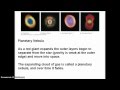
What is a planetary nebula?
A black hole.
A type of galaxy.
A type of planet.
A cloud of gas formed by the outer layers of a star.
3.
MULTIPLE CHOICE QUESTION
30 sec • 1 pt
Why is the term 'planetary nebula' misleading?
It is a type of star.
It is a type of galaxy.
It is a type of planet.
It has nothing to do with planets.
4.
MULTIPLE CHOICE QUESTION
30 sec • 1 pt
What is the typical size of a white dwarf?
The size of the Sun.
The size of Earth.
The size of a galaxy.
The size of Jupiter.
5.
MULTIPLE CHOICE QUESTION
30 sec • 1 pt
What prevents a white dwarf from collapsing under gravity?
Magnetic fields.
Dark matter.
Electron degeneracy pressure.
Nuclear fusion.
6.
MULTIPLE CHOICE QUESTION
30 sec • 1 pt
What is the fate of our Sun according to the lecture?
It will become a black hole.
It will become a neutron star.
It will become a white dwarf.
It will explode as a supernova.
7.
MULTIPLE CHOICE QUESTION
30 sec • 1 pt
What is the Chandrasekhar limit?
The maximum mass a white dwarf can have before collapsing.
The minimum mass required for a star to become a black hole.
The distance at which a star's gravity can affect another star.
The temperature at which nuclear fusion begins.
Access all questions and much more by creating a free account
Create resources
Host any resource
Get auto-graded reports

Continue with Google

Continue with Email

Continue with Classlink

Continue with Clever
or continue with

Microsoft
%20(1).png)
Apple

Others
Already have an account?


