
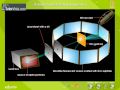
Rutherford's Atomic Model and Experiments

Interactive Video
•
Physics
•
9th - 10th Grade
•
Practice Problem
•
Hard

Patricia Brown
FREE Resource
Read more
9 questions
Show all answers
1.
MULTIPLE CHOICE QUESTION
30 sec • 1 pt
Who is credited with the discovery of the nucleus of an atom?
Marie Curie
Lord Ernest Rutherford
Niels Bohr
Albert Einstein
2.
MULTIPLE CHOICE QUESTION
30 sec • 1 pt
What material was used as the target in Rutherford's experiment?
Aluminum foil
Copper foil
Gold foil
Silver foil
3.
MULTIPLE CHOICE QUESTION
30 sec • 1 pt
What was the purpose of the lead block in the experimental setup?
To prevent air interference
To detect scattered particles
To focus the alpha particles into a narrow beam
To absorb alpha particles
4.
MULTIPLE CHOICE QUESTION
30 sec • 1 pt
How were the scattered alpha particles detected in the experiment?
Using a Geiger counter
With a zinc sulfide screen
By a photographic plate
Through a digital sensor
5.
MULTIPLE CHOICE QUESTION
30 sec • 1 pt
What did the scintillations on the screen indicate?
The absorption of gamma rays
The deflection of alpha particles
The emission of neutrons
The presence of beta particles
6.
MULTIPLE CHOICE QUESTION
30 sec • 1 pt
What conclusion was drawn from the fact that most alpha particles passed through the foil without deflection?
Atoms are filled with electrons
Atoms are solid throughout
Atoms have a dense outer shell
Atoms are mostly empty space
7.
MULTIPLE CHOICE QUESTION
30 sec • 1 pt
What is the positively charged region in an atom called?
Electron cloud
Proton field
Neutron zone
Nucleus
Access all questions and much more by creating a free account
Create resources
Host any resource
Get auto-graded reports

Continue with Google

Continue with Email

Continue with Classlink

Continue with Clever
or continue with

Microsoft
%20(1).png)
Apple

Others
Already have an account?
Popular Resources on Wayground

15 questions
Fractions on a Number Line

Quiz
•
3rd Grade
20 questions
Equivalent Fractions
Quiz
•
3rd Grade
25 questions
Multiplication Facts
Quiz
•
5th Grade
29 questions
Alg. 1 Section 5.1 Coordinate Plane
Quiz
•
9th Grade
22 questions
fractions
Quiz
•
3rd Grade
11 questions
FOREST Effective communication

Lesson
•
KG
20 questions
Main Idea and Details
Quiz
•
5th Grade
20 questions
Context Clues
Quiz
•
6th Grade
Discover more resources for Physics
10 questions
Exit Check 4.1 - Destructive Processes
Quiz
•
9th Grade
10 questions
Exit Check 4.2 - Constructive Forces
Quiz
•
9th Grade
10 questions
Exit Check 4.3 - Conservation of Momentum
Quiz
•
9th Grade
10 questions
Exit Check 4.4 - Momentum Calculations
Quiz
•
9th Grade
21 questions
EM Spectrum
Quiz
•
6th - 9th Grade
20 questions
Simple Machines and Mechanical Advantage Quiz
Quiz
•
9th Grade
14 questions
Graphs of Motion, Velocity & Acceleration
Quiz
•
8th - 9th Grade
21 questions
PE & KE Practice
Quiz
•
8th - 11th Grade