
Polyhedra and Area Calculations

Interactive Video
•
Mathematics
•
6th - 7th Grade
•
Practice Problem
•
Hard
Thomas White
FREE Resource
Read more
10 questions
Show all answers
1.
MULTIPLE CHOICE QUESTION
30 sec • 1 pt
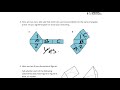
What is the main reason the net in problem 1 cannot form a complete cube?
The squares are not the same size.
One square cannot be used as a top or bottom.
It lacks enough squares to form a cube.
It has too many squares.
2.
MULTIPLE CHOICE QUESTION
30 sec • 1 pt
Which polyhedron can be formed from a net with two triangles and several rectangles?
Pyramid
Rectangular Prism
Cube
Triangular Prism
3.
MULTIPLE CHOICE QUESTION
30 sec • 1 pt
How do you calculate the area of a triangle?
Base times height
Base times height divided by 2
Length times width
Length times width divided by 2
4.
MULTIPLE CHOICE QUESTION
30 sec • 1 pt
What is the total surface area of the triangular prism discussed in the lesson?
84 square units
90 square units
72 square units
60 square units
5.
MULTIPLE CHOICE QUESTION
30 sec • 1 pt
Do both nets in question three form the same triangular prism?
Yes, but only if rearranged.
No, they have different triangular bases.
No, they have different rectangles.
Yes, they have matching triangular bases and rectangles.
6.
MULTIPLE CHOICE QUESTION
30 sec • 1 pt
Which statement is true about figure A and B?
Both have more vertices than edges.
Both are polyhedra.
Neither has rectangular faces.
Only one has triangular faces.
7.
MULTIPLE CHOICE QUESTION
30 sec • 1 pt
Which of the following units can be used for surface area?
Cubic inches
Square meters
Meters
Liters
Access all questions and much more by creating a free account
Create resources
Host any resource
Get auto-graded reports

Continue with Google

Continue with Email

Continue with Classlink

Continue with Clever
or continue with

Microsoft
%20(1).png)
Apple

Others
Already have an account?

