
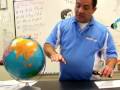
Planetary Seasons and Sunlight Effects

Interactive Video
•
Science, Geography, Physics
•
6th - 8th Grade
•
Practice Problem
•
Hard

Patricia Brown
FREE Resource
Read more
10 questions
Show all answers
1.
MULTIPLE CHOICE QUESTION
30 sec • 1 pt
What does the term 'solstice' mean in Latin?
Sun stand still
Equal night
Sunrise
Sunset
2.
MULTIPLE CHOICE QUESTION
30 sec • 1 pt
During which dates does the summer solstice occur?
March 20 or 21
June 21 or 22
September 22 or 23
December 21 or 22
3.
MULTIPLE CHOICE QUESTION
30 sec • 1 pt
Why is it hotter in the Northern Hemisphere during the summer solstice?
The Southern Hemisphere is tilted towards the Sun
The Sun is larger
The Northern Hemisphere receives more direct sunlight
The Earth is closer to the Sun
4.
MULTIPLE CHOICE QUESTION
30 sec • 1 pt
What happens during the fall equinox?
Both hemispheres experience equal amounts of daylight and night
The Northern Hemisphere experiences 24 hours of daylight
The Earth is tilted at a 45-degree angle
The Southern Hemisphere experiences 24 hours of night
5.
MULTIPLE CHOICE QUESTION
30 sec • 1 pt
During the winter solstice, which hemisphere receives more direct sunlight?
Neither hemisphere
Southern Hemisphere
Northern Hemisphere
Both hemispheres equally
6.
MULTIPLE CHOICE QUESTION
30 sec • 1 pt
In the lab experiment, what shape does the light form when the meter stick is at a 90-degree angle?
Ellipse
Square
Circle
Triangle
7.
MULTIPLE CHOICE QUESTION
30 sec • 1 pt
What is the purpose of lowering the meter stick to a 30-degree angle in the experiment?
To create a larger shadow
To simulate the angle of sunlight during winter
To demonstrate the effect of angled sunlight
To increase the intensity of light
Access all questions and much more by creating a free account
Create resources
Host any resource
Get auto-graded reports

Continue with Google

Continue with Email

Continue with Classlink

Continue with Clever
or continue with

Microsoft
%20(1).png)
Apple

Others
Already have an account?


