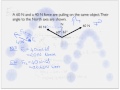
Force Components and Trigonometry

Interactive Video
•
Physics, Mathematics, Science
•
9th - 12th Grade
•
Practice Problem
•
Hard

Patricia Brown
FREE Resource
Read more
10 questions
Show all answers
1.
MULTIPLE CHOICE QUESTION
30 sec • 1 pt
Why might it be necessary to use components of forces?
To simplify calculations when forces are in a single plane.
To add forces that are not aligned or in a single plane.
To increase the magnitude of the forces.
To change the direction of the forces.
2.
MULTIPLE CHOICE QUESTION
30 sec • 1 pt
What is the first step in breaking forces into components?
Measuring the angle between the forces.
Drawing the resultant force.
Calculating the magnitude of the forces.
Choosing the axes and deciding the positive direction.
3.
MULTIPLE CHOICE QUESTION
30 sec • 1 pt
When drawing components, what is the rule regarding the dotted lines?
They must be longer than the original force.
They must form a right angle with each other.
They must add up to the original force.
They must be parallel to each other.
4.
MULTIPLE CHOICE QUESTION
30 sec • 1 pt
How do you calculate the north-south component of a force using trigonometry?
By using the cotangent of the angle.
By using the tangent of the angle.
By using the cosine of the angle.
By using the sine of the angle.
5.
MULTIPLE CHOICE QUESTION
30 sec • 1 pt
What is the result when you add two northern forces together?
A smaller force in the northern direction.
A larger force in the northern direction.
A force in the eastern direction.
A force in the southern direction.
6.
MULTIPLE CHOICE QUESTION
30 sec • 1 pt
How should you handle a negative component when adding forces?
Ignore the negative sign.
Add it as a positive component.
Subtract it from the positive component.
Rewrite it as a positive in the opposite direction.
7.
MULTIPLE CHOICE QUESTION
30 sec • 1 pt
In the real-world application example, what is the effect of the perpendicular component?
It moves the object upwards.
It balances the weight of the object.
It has no significant effect on the object's movement.
It increases the frictional force.
Access all questions and much more by creating a free account
Create resources
Host any resource
Get auto-graded reports

Continue with Google

Continue with Email

Continue with Classlink

Continue with Clever
or continue with

Microsoft
%20(1).png)
Apple

Others
Already have an account?
Popular Resources on Wayground

15 questions
Fractions on a Number Line

Quiz
•
3rd Grade
20 questions
Equivalent Fractions
Quiz
•
3rd Grade
25 questions
Multiplication Facts
Quiz
•
5th Grade
54 questions
Analyzing Line Graphs & Tables
Quiz
•
4th Grade
22 questions
fractions
Quiz
•
3rd Grade
20 questions
Main Idea and Details
Quiz
•
5th Grade
20 questions
Context Clues
Quiz
•
6th Grade
15 questions
Equivalent Fractions
Quiz
•
4th Grade
Discover more resources for Physics
27 questions
Simple Machines and Mechanical Advantage Quiz
Quiz
•
9th Grade
16 questions
Coulomb's Law
Quiz
•
11th Grade
10 questions
Understanding Heat, Thermal Energy, and Temperature
Interactive video
•
9th - 10th Grade
10 questions
Newton's Laws of Motion
Quiz
•
10th Grade
10 questions
unit 10 -- electric forces and fields

Lesson
•
9th - 12th Grade
21 questions
Diffraction, Reflection, Refraction
Quiz
•
9th - 12th Grade
15 questions
Position vs. Time and Velocity vs. Time Graphs
Quiz
•
10th - 12th Grade
10 questions
Types of Chemical Reactions
Quiz
•
10th Grade