
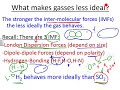
Intermolecular Forces and Gas Behavior

Interactive Video
•
Chemistry, Physics, Science
•
9th - 12th Grade
•
Practice Problem
•
Hard

Patricia Brown
FREE Resource
Read more
10 questions
Show all answers
1.
MULTIPLE CHOICE QUESTION
30 sec • 1 pt
What is the primary factor that makes gases deviate from ideal behavior?
Pressure
Temperature
Volume
Intermolecular forces
2.
MULTIPLE CHOICE QUESTION
30 sec • 1 pt
Which type of intermolecular force is dependent on the size of the molecule?
Covalent bonding
London dispersion forces
Ionic bonding
Hydrogen bonding
3.
MULTIPLE CHOICE QUESTION
30 sec • 1 pt
What is the relationship between molecular size and London dispersion forces?
Larger molecules have weaker forces
Smaller molecules have stronger forces
Size does not affect dispersion forces
Larger molecules have stronger forces
4.
MULTIPLE CHOICE QUESTION
30 sec • 1 pt
What causes dipole-dipole forces to occur between molecules?
Low pressure
High temperature
Polar molecules
Nonpolar molecules
5.
MULTIPLE CHOICE QUESTION
30 sec • 1 pt
Which of the following is an example of a molecule that exhibits hydrogen bonding?
Ammonia (NH3)
Carbon dioxide (CO2)
Methane (CH4)
Oxygen (O2)
6.
MULTIPLE CHOICE QUESTION
30 sec • 1 pt
Why does sulfur dioxide (SO2) deviate more from ideal gas behavior compared to hydrogen (H2)?
SO2 is nonpolar
SO2 has stronger intermolecular forces
H2 is larger in size
H2 has dipole-dipole forces
7.
MULTIPLE CHOICE QUESTION
30 sec • 1 pt
How does the presence of a lone pair affect the geometry and polarity of SO2?
It makes SO2 linear and nonpolar
It has no effect on SO2's geometry
It makes SO2 bent and polar
It makes SO2 tetrahedral and nonpolar
Access all questions and much more by creating a free account
Create resources
Host any resource
Get auto-graded reports

Continue with Google

Continue with Email

Continue with Classlink

Continue with Clever
or continue with

Microsoft
%20(1).png)
Apple

Others
Already have an account?


