
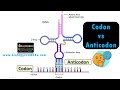
Codons and Anticodons in Protein Synthesis

Interactive Video
•
Biology, Science
•
9th - 12th Grade
•
Practice Problem
•
Hard

Patricia Brown
FREE Resource
Read more
10 questions
Show all answers
1.
MULTIPLE CHOICE QUESTION
30 sec • 1 pt
What is the primary function of both codons and anticodons in molecular biology?
To break down proteins
To position amino acids in the correct sequence during protein synthesis
To replicate DNA
To synthesize carbohydrates
2.
MULTIPLE CHOICE QUESTION
30 sec • 1 pt
Which of the following best describes a codon?
A triplet of nucleotides in mRNA that codes for an amino acid
A single nucleotide in DNA
A sequence of amino acids
A protein that binds to DNA
3.
MULTIPLE CHOICE QUESTION
30 sec • 1 pt
Where is an anticodon found?
In mRNA
In DNA
In tRNA
In ribosomes
4.
MULTIPLE CHOICE QUESTION
30 sec • 1 pt
How does an anticodon relate to a codon?
It is a protein that interacts with the codon
It is identical to the codon
It is a random sequence of nucleotides
It is complementary to the codon
5.
MULTIPLE CHOICE QUESTION
30 sec • 1 pt
Which of the following is true about the relationship between codons and anticodons?
Codons are found in tRNA, while anticodons are in mRNA
Codons and anticodons are complementary sequences
Codons and anticodons are unrelated
Codons and anticodons are identical sequences
6.
MULTIPLE CHOICE QUESTION
30 sec • 1 pt
What is the role of a codon in mRNA?
To synthesize carbohydrates
To transport amino acids
To replicate DNA
To determine the position of amino acids in a protein
7.
MULTIPLE CHOICE QUESTION
30 sec • 1 pt
What does the start codon AUG code for?
Glutamate
Lysine
Methionine
Phenylalanine
Access all questions and much more by creating a free account
Create resources
Host any resource
Get auto-graded reports

Continue with Google

Continue with Email

Continue with Classlink

Continue with Clever
or continue with

Microsoft
%20(1).png)
Apple

Others
Already have an account?

