
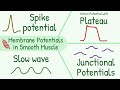
Smooth Muscle Potentials and Functions

Interactive Video
•
Biology, Science, Other
•
10th - 12th Grade
•
Practice Problem
•
Hard

Patricia Brown
FREE Resource
Read more
10 questions
Show all answers
1.
MULTIPLE CHOICE QUESTION
30 sec • 1 pt
What is the resting membrane potential range in smooth muscles?
-70 to -80 millivolts
-50 to -60 millivolts
-40 to -50 millivolts
-60 to -70 millivolts
2.
MULTIPLE CHOICE QUESTION
30 sec • 1 pt
Which type of action potential in smooth muscles is similar to that in cardiac muscles?
Junctional potential
Slow wave potential
Action potential with plateau
Spike potential
3.
MULTIPLE CHOICE QUESTION
30 sec • 1 pt
What primarily contributes to the action potential in smooth muscles?
Sodium channels
Potassium channels
Chloride channels
Calcium channels
4.
MULTIPLE CHOICE QUESTION
30 sec • 1 pt
What is the role of calcium in smooth muscle action potentials?
In neither stimulation nor contraction
In both stimulation and contraction
Only in contraction
Only in stimulation
5.
MULTIPLE CHOICE QUESTION
30 sec • 1 pt
What is believed to cause slow wave potentials in smooth muscles?
External stimulation
Cyclic changes in ion pumping
Constant ion influx
Neuronal stimulation
6.
MULTIPLE CHOICE QUESTION
30 sec • 1 pt
Where are slow wave potentials commonly observed?
In the heart
In the brain
In skeletal muscles
In gut smooth muscles
7.
MULTIPLE CHOICE QUESTION
30 sec • 1 pt
What is the function of slow wave potentials in smooth muscles?
To inhibit muscle contraction
To maintain resting potential
To directly cause muscle contraction
To elicit action potentials
Access all questions and much more by creating a free account
Create resources
Host any resource
Get auto-graded reports

Continue with Google

Continue with Email

Continue with Classlink

Continue with Clever
or continue with

Microsoft
%20(1).png)
Apple

Others
Already have an account?

