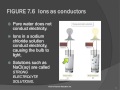
Ionic Compounds and Electrolytes

Interactive Video
•
Chemistry, Science, Physics
•
9th - 10th Grade
•
Practice Problem
•
Hard

Patricia Brown
FREE Resource
Read more
10 questions
Show all answers
1.
MULTIPLE CHOICE QUESTION
30 sec • 1 pt
What does the abbreviation 'EQ' stand for in the context of aqueous solutions?
Dissolved in water
Equation
Equal
Equilibrium
2.
MULTIPLE CHOICE QUESTION
30 sec • 1 pt
What happens to ionic compounds when they dissolve in water?
They form a new compound
They remain intact
They dissociate into individual ions
They evaporate
3.
MULTIPLE CHOICE QUESTION
30 sec • 1 pt
What is a strong electrolyte?
A substance that dissociates completely into ions
A substance that evaporates quickly
A substance that does not conduct electricity
A substance that partially dissociates in water
4.
MULTIPLE CHOICE QUESTION
30 sec • 1 pt
Why is pure water not a good conductor of electricity?
It lacks ions to carry the charge
It is too pure
It has too many ions
It is too dense
5.
MULTIPLE CHOICE QUESTION
30 sec • 1 pt
What is the role of ions in conducting electricity in a solution?
They dissolve the electrodes
They carry the electrical charge
They block the flow of electrons
They prevent conduction
6.
MULTIPLE CHOICE QUESTION
30 sec • 1 pt
What is the main difference between a strong electrolyte and pure water in terms of conductivity?
Strong electrolytes do not conduct electricity
Pure water conducts electricity better
Strong electrolytes conduct electricity due to ions
Pure water has more ions
7.
MULTIPLE CHOICE QUESTION
30 sec • 1 pt
What happens when silver nitrate dissolves in water?
It forms a precipitate
It dissociates into silver and nitrate ions
It remains as a solid
It evaporates
Access all questions and much more by creating a free account
Create resources
Host any resource
Get auto-graded reports

Continue with Google

Continue with Email

Continue with Classlink

Continue with Clever
or continue with

Microsoft
%20(1).png)
Apple

Others
Already have an account?
Similar Resources on Wayground

11 questions
Understanding Antimatter and the Universe
Interactive video
•
9th - 12th Grade
11 questions
Photosynthesis Mechanisms and Processes
Interactive video
•
9th - 12th Grade
11 questions
Chemical Concepts and Calculations
Interactive video
•
10th - 12th Grade
9 questions
CS2 Molecular Geometry and Bonding
Interactive video
•
9th - 10th Grade
10 questions
Agricultural Politics and Trade Dynamics
Interactive video
•
9th - 12th Grade
11 questions
Acids and Bases Concepts
Interactive video
•
9th - 12th Grade
11 questions
Understanding Correlation and Causation
Interactive video
•
9th - 12th Grade
11 questions
Chemistry Lesson on Amphoteric Behavior of Alumina
Interactive video
•
9th - 12th Grade
Popular Resources on Wayground
7 questions
History of Valentine's Day
Interactive video
•
4th Grade
15 questions
Fractions on a Number Line

Quiz
•
3rd Grade
20 questions
Equivalent Fractions
Quiz
•
3rd Grade
25 questions
Multiplication Facts
Quiz
•
5th Grade
22 questions
fractions
Quiz
•
3rd Grade
15 questions
Valentine's Day Trivia
Quiz
•
3rd Grade
20 questions
Main Idea and Details
Quiz
•
5th Grade
20 questions
Context Clues
Quiz
•
6th Grade
Discover more resources for Chemistry
25 questions
Unit 8 Stoichiometry Review
Quiz
•
10th Grade
20 questions
Types of Chemical Reactions
Quiz
•
9th - 12th Grade
19 questions
Stoichiometry, Limiting Reactants, and Percent Yield
Quiz
•
10th Grade
10 questions
Formative 3BD: Ionic Bonds
Quiz
•
9th Grade
15 questions
Balancing Chemical Equations
Quiz
•
10th - 12th Grade
20 questions
Naming & Writing Chemical Formulas
Quiz
•
10th Grade
10 questions
Identifying types of reactions
Quiz
•
9th - 12th Grade
20 questions
Periodic Trends
Quiz
•
10th Grade