
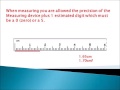
Measurement Accuracy and Estimation Concepts

Interactive Video
•
Mathematics, Science, Other
•
6th - 7th Grade
•
Practice Problem
•
Hard

Patricia Brown
FREE Resource
Read more
10 questions
Show all answers
1.
MULTIPLE CHOICE QUESTION
30 sec • 1 pt
What is the primary tool used for measurement in this practice session?
Protractor
Inch ruler
Centimeter ruler
Tape measure
2.
MULTIPLE CHOICE QUESTION
30 sec • 1 pt
To what decimal place should measurements be rounded?
Nearest whole number
Nearest thousandth
Nearest hundredth
Nearest tenth
3.
MULTIPLE CHOICE QUESTION
30 sec • 1 pt
What is the rule for the last digit in a measurement?
It must be a zero or a five
It can be any number
It must be a one or a six
It must be a two or a seven
4.
MULTIPLE CHOICE QUESTION
30 sec • 1 pt
Why is there always an error in the last digit of a measurement?
Because the ruler is inaccurate
Because the line is not straight
Because the last digit is an estimated position
Because the ruler is too short
5.
MULTIPLE CHOICE QUESTION
30 sec • 1 pt
If a line measures 2.45 cm, what does the '5' in the last digit indicate?
The line is closer to 2.40 cm
The line is exactly 2.45 cm
The line is halfway between two marks
The line is closer to 2.50 cm
6.
MULTIPLE CHOICE QUESTION
30 sec • 1 pt
What does it mean if a measurement is written as 1.70 cm?
The line is closer to 1.65 cm
The line is halfway between 1.65 cm and 1.70 cm
The line is exactly 1.70 cm
The line is closer to 1.75 cm
7.
MULTIPLE CHOICE QUESTION
30 sec • 1 pt
What is the significance of the range between two measurements like 1.65 cm and 1.70 cm?
It means the line is shorter than 1.65 cm
It means the line is longer than 1.70 cm
It indicates the possible error range
It shows the exact length of the line
Access all questions and much more by creating a free account
Create resources
Host any resource
Get auto-graded reports

Continue with Google

Continue with Email

Continue with Classlink

Continue with Clever
or continue with

Microsoft
%20(1).png)
Apple

Others
Already have an account?


