
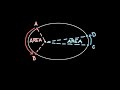
Kepler's Laws and Orbital Motion

Interactive Video
•
Physics, Mathematics, Science
•
9th - 12th Grade
•
Practice Problem
•
Hard

Patricia Brown
FREE Resource
Read more
10 questions
Show all answers
1.
MULTIPLE CHOICE QUESTION
30 sec • 1 pt
What does Kepler's Second Law state about the motion of an object in orbit?
It maintains a constant speed.
It sweeps through equal areas in equal times.
It moves faster at aphelion.
It moves in a perfect circle.
2.
MULTIPLE CHOICE QUESTION
30 sec • 1 pt
If an object takes the same time to travel from point A to B and from C to D, what can be said about the areas covered?
The area from A to B is larger.
The area from C to D is larger.
Both areas are equal.
The areas cannot be compared.
3.
MULTIPLE CHOICE QUESTION
30 sec • 1 pt
At which point in its orbit does Earth travel faster?
At aphelion.
At perihelion.
It travels at a constant speed.
At the midpoint.
4.
MULTIPLE CHOICE QUESTION
30 sec • 1 pt
What is Earth's average velocity in its orbit?
29.3 km/s
30 km/s
28 km/s
29.8 km/s
5.
MULTIPLE CHOICE QUESTION
30 sec • 1 pt
How is the length of an arc in an elliptical orbit calculated?
By multiplying the radius by the angle.
By dividing the radius by the angle.
By adding the radius and the angle.
By subtracting the angle from the radius.
6.
MULTIPLE CHOICE QUESTION
30 sec • 1 pt
What does the term 'dA/dt' represent in the context of Kepler's Second Law?
The change in area over time.
The change in distance over time.
The change in velocity over time.
The change in mass over time.
7.
MULTIPLE CHOICE QUESTION
30 sec • 1 pt
What remains constant according to Kepler's Second Law?
Angular momentum.
Mass of the object.
Change in area over time.
Distance from the focus.
Access all questions and much more by creating a free account
Create resources
Host any resource
Get auto-graded reports

Continue with Google

Continue with Email

Continue with Classlink

Continue with Clever
or continue with

Microsoft
%20(1).png)
Apple

Others
Already have an account?

