
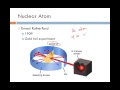
Subatomic Particles and Atomic Models

Interactive Video
•
Physics, Chemistry, Science
•
9th - 10th Grade
•
Practice Problem
•
Hard

Patricia Brown
FREE Resource
Read more
10 questions
Show all answers
1.
MULTIPLE CHOICE QUESTION
30 sec • 1 pt
What is the smallest unit of an element that retains its properties?
Electron
Proton
Atom
Molecule
2.
MULTIPLE CHOICE QUESTION
30 sec • 1 pt
Who discovered the electron using a cathode ray tube?
J.J. Thompson
Marie Curie
Ernest Rutherford
Robert Milliken
3.
MULTIPLE CHOICE QUESTION
30 sec • 1 pt
What did J.J. Thompson conclude about the cathode ray?
It was composed of light
It was composed of charged particles
It was composed of sound waves
It was composed of magnetic fields
4.
MULTIPLE CHOICE QUESTION
30 sec • 1 pt
What model did Thompson propose for the atom?
Nuclear model
Quantum model
Solar system model
Plum pudding model
5.
MULTIPLE CHOICE QUESTION
30 sec • 1 pt
Who discovered that certain elements emit energetic particles and rays?
Robert Milliken
Ernest Rutherford
Henri Becquerel and Marie Curie
J.J. Thompson
6.
MULTIPLE CHOICE QUESTION
30 sec • 1 pt
What did Rutherford's gold foil experiment demonstrate about the atom?
Atoms are solid throughout
Atoms have a dense nucleus
Atoms are indivisible
Atoms are made of light
7.
MULTIPLE CHOICE QUESTION
30 sec • 1 pt
What is the charge of the nucleus according to Rutherford's model?
Variable
Positive
Neutral
Negative
Access all questions and much more by creating a free account
Create resources
Host any resource
Get auto-graded reports

Continue with Google

Continue with Email

Continue with Classlink

Continue with Clever
or continue with

Microsoft
%20(1).png)
Apple

Others
Already have an account?
Similar Resources on Wayground

11 questions
Molecular Geometry of N2H2
Interactive video
•
9th - 10th Grade
8 questions
Understanding Aging and Disease Prevention
Interactive video
•
9th - 12th Grade
11 questions
Game Development Insights and Challenges
Interactive video
•
9th - 10th Grade
9 questions
CS2 Molecular Geometry and Bonding
Interactive video
•
9th - 10th Grade
9 questions
3-Methyl Hexane Structure and Properties
Interactive video
•
9th - 10th Grade
10 questions
Electron Configuration and Atomic Structure
Interactive video
•
9th - 10th Grade
10 questions
Molecular Geometry and Bonding Concepts
Interactive video
•
9th - 10th Grade
Popular Resources on Wayground
7 questions
History of Valentine's Day
Interactive video
•
4th Grade
15 questions
Fractions on a Number Line

Quiz
•
3rd Grade
20 questions
Equivalent Fractions
Quiz
•
3rd Grade
25 questions
Multiplication Facts
Quiz
•
5th Grade
22 questions
fractions
Quiz
•
3rd Grade
15 questions
Valentine's Day Trivia
Quiz
•
3rd Grade
20 questions
Main Idea and Details
Quiz
•
5th Grade
20 questions
Context Clues
Quiz
•
6th Grade
Discover more resources for Physics
10 questions
Exit Check 3.1 - Kepler's Laws
Quiz
•
9th Grade
10 questions
Exit Check 3.2 - Force of Gavity
Quiz
•
9th Grade
27 questions
Simple Machines and Mechanical Advantage Quiz
Quiz
•
9th Grade
20 questions
Unit 8 - Energy Test - 2025-2026
Quiz
•
9th - 12th Grade
19 questions
Generators, Motors, and Transformers
Quiz
•
8th Grade - University
24 questions
IPC Thermal Energy Test Corrections
Quiz
•
9th Grade
14 questions
Bill Nye Waves
Interactive video
•
9th - 12th Grade
20 questions
Ohm's Law
Quiz
•
9th Grade