
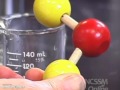
Polar Molecules and Their Behavior

Interactive Video
•
Chemistry, Science, Physics
•
9th - 10th Grade
•
Practice Problem
•
Hard

Patricia Brown
FREE Resource
Read more
10 questions
Show all answers
1.
MULTIPLE CHOICE QUESTION
30 sec • 1 pt
What is the primary focus of the initial discussion on molecular shapes?
The color of molecules
The size of molecules
The impact of shapes on chemical behavior
The weight of molecules
2.
MULTIPLE CHOICE QUESTION
30 sec • 1 pt
What happens when carbon tetrachloride is exposed to a charged rod?
It bends towards the rod
It changes color
Nothing significant happens
It evaporates
3.
MULTIPLE CHOICE QUESTION
30 sec • 1 pt
How does water behave when exposed to a charged rod?
It freezes
It remains unchanged
It bends towards the rod
It forms bubbles
4.
MULTIPLE CHOICE QUESTION
30 sec • 1 pt
What shape is the water molecule described as?
Linear
Tetrahedral
Bent or V-shaped
Square
5.
MULTIPLE CHOICE QUESTION
30 sec • 1 pt
What is the electronegativity value of oxygen compared to hydrogen?
Equal to hydrogen
Higher than hydrogen
Lower than hydrogen
Not applicable
6.
MULTIPLE CHOICE QUESTION
30 sec • 1 pt
Why is hydrogen considered slightly positive in a water molecule?
It has a higher atomic number
It has more electrons
Its electrons are closer to oxygen
It is heavier than oxygen
7.
MULTIPLE CHOICE QUESTION
30 sec • 1 pt
What does the term 'polar' refer to in the context of molecules?
Molecules with a single charge
Molecules with equal charge distribution
Molecules with no charge
Molecules with opposite charges
Access all questions and much more by creating a free account
Create resources
Host any resource
Get auto-graded reports

Continue with Google

Continue with Email

Continue with Classlink

Continue with Clever
or continue with

Microsoft
%20(1).png)
Apple

Others
Already have an account?

