
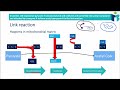
Link Reaction in Cellular Respiration

Interactive Video
•
Biology, Science
•
9th - 10th Grade
•
Practice Problem
•
Hard

Patricia Brown
FREE Resource
Read more
10 questions
Show all answers
1.
MULTIPLE CHOICE QUESTION
30 sec • 1 pt
What is the primary purpose of the link reaction in cell respiration?
To convert glucose into pyruvate
To transport electrons to the electron transport chain
To convert pyruvate into acetyl-CoA
To produce ATP directly
2.
MULTIPLE CHOICE QUESTION
30 sec • 1 pt
Where does the link reaction occur within the cell?
In the nucleus
In the mitochondrial matrix
In the endoplasmic reticulum
In the cytoplasm
3.
MULTIPLE CHOICE QUESTION
30 sec • 1 pt
What happens to pyruvate during the decarboxylation step of the link reaction?
It gains a carbon atom
It loses a carbon atom as CO2
It is converted into glucose
It is directly used to produce ATP
4.
MULTIPLE CHOICE QUESTION
30 sec • 1 pt
Which molecule is reduced during the oxidation of pyruvate in the link reaction?
FAD
ATP
NAD+
ADP
5.
MULTIPLE CHOICE QUESTION
30 sec • 1 pt
What is the final product of the link reaction?
Glucose
Pyruvate
Lactic acid
Acetyl-CoA
6.
MULTIPLE CHOICE QUESTION
30 sec • 1 pt
What role does coenzyme A play in the link reaction?
It directly produces ATP
It combines with the two-carbon molecule to form acetyl-CoA
It helps in the decarboxylation of pyruvate
It acts as an electron carrier
7.
MULTIPLE CHOICE QUESTION
30 sec • 1 pt
Which process is responsible for the loss of electrons during the link reaction?
Reduction
Oxidation
Phosphorylation
Hydrolysis
Access all questions and much more by creating a free account
Create resources
Host any resource
Get auto-graded reports

Continue with Google

Continue with Email

Continue with Classlink

Continue with Clever
or continue with

Microsoft
%20(1).png)
Apple

Others
Already have an account?

