
Resonance Structures and Bonding Concepts

Interactive Video
•
Chemistry, Science, Biology
•
9th - 12th Grade
•
Practice Problem
•
Hard

Patricia Brown
FREE Resource
Read more
10 questions
Show all answers
1.
MULTIPLE CHOICE QUESTION
30 sec • 1 pt
What type of elements typically form covalent bonds?
Metal and metal
Noble gases
Non-metal and non-metal
Metal and non-metal
2.
MULTIPLE CHOICE QUESTION
30 sec • 1 pt
What happens to potential energy as two hydrogen atoms form a covalent bond?
It fluctuates
It increases
It remains constant
It decreases
3.
MULTIPLE CHOICE QUESTION
30 sec • 1 pt
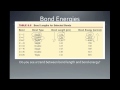
What is the relationship between bond length and bond energy?
Directly proportional
Inversely proportional
No relationship
Both increase together
4.
MULTIPLE CHOICE QUESTION
30 sec • 1 pt
Which bond is the strongest among single, double, and triple bonds?
Single bond
Double bond
Triple bond
All are equally strong
5.
MULTIPLE CHOICE QUESTION
30 sec • 1 pt
What is the octet rule?
Atoms aim to have eight electrons in total
Atoms aim to have eight neutrons
Atoms aim to have eight protons
Atoms aim to have eight valence electrons
6.
MULTIPLE CHOICE QUESTION
30 sec • 1 pt
Which element is an exception to the octet rule, being satisfied with only two electrons?
Nitrogen
Carbon
Hydrogen
Oxygen
7.
MULTIPLE CHOICE QUESTION
30 sec • 1 pt
What do electron dot diagrams represent?
Number of protons
Number of neutrons
Number of valence electrons
Number of total electrons
Access all questions and much more by creating a free account
Create resources
Host any resource
Get auto-graded reports

Continue with Google

Continue with Email

Continue with Classlink

Continue with Clever
or continue with

Microsoft
%20(1).png)
Apple

Others
Already have an account?

