
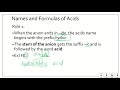
Naming and Formulas of Acids and Bases

Interactive Video
•
Chemistry, Science, Biology
•
9th - 10th Grade
•
Practice Problem
•
Hard

Patricia Brown
FREE Resource
Read more
10 questions
Show all answers
1.
MULTIPLE CHOICE QUESTION
30 sec • 1 pt
What is a key characteristic of an acid's chemical formula?
It always ends with OH.
It always starts with H.
It contains a metal cation.
It is always a solid at room temperature.
2.
MULTIPLE CHOICE QUESTION
30 sec • 1 pt
How do you name an acid when the anion ends in 'IDE'?
Add the suffix 'ite'.
Add the suffix 'ous'.
Add the prefix 'hydro' and suffix 'ic'.
Add the prefix 'per' and suffix 'ate'.
3.
MULTIPLE CHOICE QUESTION
30 sec • 1 pt
What suffix is used for acids when the anion ends in 'ITE'?
'ate'
'ide'
'ous'
'ic'
4.
MULTIPLE CHOICE QUESTION
30 sec • 1 pt
Which rule applies when naming an acid with an anion ending in 'ATE'?
Use the prefix 'hydro' and suffix 'ic'.
Use the suffix 'ous'.
Use the prefix 'per' and suffix 'ate'.
Use the suffix 'ic'.
5.
MULTIPLE CHOICE QUESTION
30 sec • 1 pt
What is the first step in writing the formula for an acid?
Add a hydroxide ion.
Identify the metal cation.
Determine the number of oxygen atoms.
Use the naming rule in reverse.
6.
MULTIPLE CHOICE QUESTION
30 sec • 1 pt
What is an exception to the naming rule for acids with 'ITE' anions?
Nitrate becomes nitric acid.
Sulfite becomes sulfurous acid.
Sulfate becomes sulfuric acid.
Chloride becomes chloric acid.
7.
MULTIPLE CHOICE QUESTION
30 sec • 1 pt
How are bases named compared to acids?
Bases use the same naming rules as acids.
Bases use the prefix 'hydro'.
Bases are named like ionic compounds.
Bases always start with H.
Access all questions and much more by creating a free account
Create resources
Host any resource
Get auto-graded reports

Continue with Google

Continue with Email

Continue with Classlink

Continue with Clever
or continue with

Microsoft
%20(1).png)
Apple

Others
Already have an account?

