
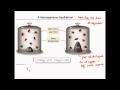
Equilibrium Expressions and Constants

Interactive Video
•
Chemistry, Science, Physics
•
11th - 12th Grade
•
Practice Problem
•
Hard

Patricia Brown
FREE Resource
Read more
10 questions
Show all answers
1.
MULTIPLE CHOICE QUESTION
30 sec • 1 pt
What is a key characteristic of a heterogeneous equilibrium?
It involves only one phase.
It involves multiple phases.
It involves only gases.
It involves only liquids.
2.
MULTIPLE CHOICE QUESTION
30 sec • 1 pt
Why do pure liquids and solids not appear in the equilibrium constant expression?
They are always in the gaseous phase.
They have a fixed volume and concentration.
Their concentration changes frequently.
They have variable volumes.
3.
MULTIPLE CHOICE QUESTION
30 sec • 1 pt
What is the significance of the fixed volume of pure solids and liquids in equilibrium?
It makes them volatile.
It keeps their concentration constant.
It changes their phase.
It allows them to spread out.
4.
MULTIPLE CHOICE QUESTION
30 sec • 1 pt
How is the equilibrium constant expressed in terms of concentrations for the reaction involving carbon dioxide and carbon monoxide?
Concentration of CO divided by concentration of CO2 squared.
Concentration of CO2 divided by concentration of CO squared.
Concentration of CO2 squared divided by concentration of CO.
Concentration of CO squared divided by concentration of CO2.
5.
MULTIPLE CHOICE QUESTION
30 sec • 1 pt
How can equilibrium constants be expressed besides using concentrations?
Using weights.
Using volumes.
Using partial pressures.
Using temperatures.
6.
MULTIPLE CHOICE QUESTION
30 sec • 1 pt
In the context of equilibrium expressions, what is typically excluded when dealing with aqueous solutions?
Aqueous reactants.
All reactants.
Gaseous reactants.
Pure solids.
7.
MULTIPLE CHOICE QUESTION
30 sec • 1 pt
What happens to the equilibrium expression when pure solids are involved?
They are doubled in the expression.
They are excluded from the expression.
They are included in the expression.
They are halved in the expression.
Access all questions and much more by creating a free account
Create resources
Host any resource
Get auto-graded reports

Continue with Google

Continue with Email

Continue with Classlink

Continue with Clever
or continue with

Microsoft
%20(1).png)
Apple

Others
Already have an account?


