
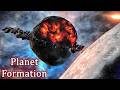
Nebulae, Exoplanets, and Stellar Evolution

Interactive Video
•
Science, Physics, Chemistry
•
9th - 10th Grade
•
Practice Problem
•
Hard

Patricia Brown
FREE Resource
Read more
10 questions
Show all answers
1.
MULTIPLE CHOICE QUESTION
30 sec • 1 pt
What are nebulae primarily composed of?
Carbon and oxygen
Hydrogen and helium
Nitrogen and sulfur
Iron and nickel
2.
MULTIPLE CHOICE QUESTION
30 sec • 1 pt
What happens during a supernova?
A galaxy collapses
A planet forms
A star explodes
A star is born
3.
MULTIPLE CHOICE QUESTION
30 sec • 1 pt
What marks the birth of a protostar?
The formation of a supernova
The collapse of a nebula
The creation of a black hole
The fusion of two stars
4.
MULTIPLE CHOICE QUESTION
30 sec • 1 pt
What is the significance of a protoplanetary disc?
It is the final stage of a star's life
It is a region of empty space
It is the birthplace of planets
It is a type of galaxy
5.
MULTIPLE CHOICE QUESTION
30 sec • 1 pt
What is the process called when dust particles stick together to form larger bodies?
Sublimation
Erosion
Accretion
Fusion
6.
MULTIPLE CHOICE QUESTION
30 sec • 1 pt
What is planetary differentiation?
The collision of two planets
The separation of a planet's layers
The process of forming a star
The evaporation of a planet's atmosphere
7.
MULTIPLE CHOICE QUESTION
30 sec • 1 pt
How can planets develop an atmosphere?
By colliding with other planets
Through the process of sublimation
By capturing gases from the protoplanetary disc
Through accretion
Access all questions and much more by creating a free account
Create resources
Host any resource
Get auto-graded reports

Continue with Google

Continue with Email

Continue with Classlink

Continue with Clever
or continue with

Microsoft
%20(1).png)
Apple

Others
Already have an account?


