
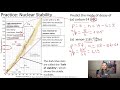
Nuclear Stability and Decay Processes

Interactive Video
•
Physics, Chemistry, Science
•
9th - 12th Grade
•
Practice Problem
•
Hard

Patricia Brown
FREE Resource
Read more
10 questions
Show all answers
1.
MULTIPLE CHOICE QUESTION
30 sec • 1 pt
What are the two main factors that help identify the stability of an isotope?
Neutron-to-proton ratio and total number of nucleons
Atomic number and mass number
Electron configuration and atomic radius
Valence electrons and ionization energy
2.
MULTIPLE CHOICE QUESTION
30 sec • 1 pt
For smaller nuclei with an atomic number below 20, what is the typical neutron-to-proton ratio for stability?
3:1
1:1
2:1
1:2
3.
MULTIPLE CHOICE QUESTION
30 sec • 1 pt
What type of decay is characteristic for a nucleus with too many neutrons compared to protons?
Positron emission
Gamma decay
Beta decay
Alpha decay
4.
MULTIPLE CHOICE QUESTION
30 sec • 1 pt
If a nucleus has too few neutrons or too many protons, which decay process might it undergo?
Beta decay
Alpha decay
Positron emission or electron capture
Gamma decay
5.
MULTIPLE CHOICE QUESTION
30 sec • 1 pt
Which decay process generally reduces the mass of the nuclei?
Positron emission
Beta decay
Gamma decay
Alpha decay
6.
MULTIPLE CHOICE QUESTION
30 sec • 1 pt
What is the neutron-to-proton ratio for Carbon-14, and what decay process does it undergo?
1.25, Beta decay
1.5, Alpha decay
1.0, Positron emission
1.75, Electron capture
7.
MULTIPLE CHOICE QUESTION
30 sec • 1 pt
For Xenon-118, what is the neutron-to-proton ratio, and what decay process is likely?
1.19, Positron emission or electron capture
1.19, Alpha decay
1.0, Gamma decay
1.4, Beta decay
Access all questions and much more by creating a free account
Create resources
Host any resource
Get auto-graded reports

Continue with Google

Continue with Email

Continue with Classlink

Continue with Clever
or continue with

Microsoft
%20(1).png)
Apple

Others
Already have an account?


