
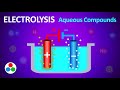
Electrolysis and Ionic Compounds

Interactive Video
•
Chemistry, Science, Physics
•
9th - 10th Grade
•
Practice Problem
•
Hard

Patricia Brown
FREE Resource
Read more
10 questions
Show all answers
1.
MULTIPLE CHOICE QUESTION
30 sec • 1 pt
What are ionic compounds composed of?
Positive and negative metal ions
Only non-metal ions
Positive metal ions and negative non-metal ions
Neutral atoms
2.
MULTIPLE CHOICE QUESTION
30 sec • 1 pt
What makes molten ionic compounds simpler for electrolysis?
They do not conduct electricity
They contain only two ions
They are solid at room temperature
They contain only one type of ion
3.
MULTIPLE CHOICE QUESTION
30 sec • 1 pt
What happens to sodium chloride when it dissolves in water?
It forms a solid precipitate
It dissociates into sodium and chloride ions
It remains unchanged
It forms a gas
4.
MULTIPLE CHOICE QUESTION
30 sec • 1 pt
Which ion is reduced at the cathode during the electrolysis of brine?
Hydrogen ion
Hydroxide ion
Sodium ion
Chloride ion
5.
MULTIPLE CHOICE QUESTION
30 sec • 1 pt
Why is hydrogen reduced at the cathode instead of sodium?
Hydrogen is more reactive than sodium
Sodium is a non-metal
Sodium is more reactive than hydrogen
Hydrogen is a metal
6.
MULTIPLE CHOICE QUESTION
30 sec • 1 pt
What is the term for the gain of electrons?
Oxidation
Reduction
Electrolysis
Dissociation
7.
MULTIPLE CHOICE QUESTION
30 sec • 1 pt
What is the rule for determining which ion is oxidized at the anode?
Only metal ions are oxidized
Halide ions are oxidized if present
The least reactive ion is oxidized
The most reactive ion is oxidized
Access all questions and much more by creating a free account
Create resources
Host any resource
Get auto-graded reports

Continue with Google

Continue with Email

Continue with Classlink

Continue with Clever
or continue with

Microsoft
%20(1).png)
Apple

Others
Already have an account?
Similar Resources on Wayground

6 questions
Hubble Space Telescope Discoveries Quiz
Interactive video
•
9th - 10th Grade
6 questions
Understanding Hydrogen Reactions
Interactive video
•
9th - 10th Grade
6 questions
SPHEREx Mission Quiz
Interactive video
•
9th - 10th Grade
6 questions
Exploring Neptune: The Ice Giant
Interactive video
•
9th - 10th Grade
6 questions
Understanding Homolytic Dissociation of HCl
Interactive video
•
9th - 10th Grade
11 questions
The Invention and Impact of Nylon
Interactive video
•
9th - 10th Grade
11 questions
Pulsar-Based Navigation and Its Applications
Interactive video
•
9th - 10th Grade
6 questions
Arrhenius Acid and Base Theory Quiz
Interactive video
•
9th - 10th Grade
Popular Resources on Wayground
15 questions
Fractions on a Number Line

Quiz
•
3rd Grade
20 questions
Equivalent Fractions
Quiz
•
3rd Grade
25 questions
Multiplication Facts
Quiz
•
5th Grade
29 questions
Alg. 1 Section 5.1 Coordinate Plane
Quiz
•
9th Grade
22 questions
fractions
Quiz
•
3rd Grade
11 questions
FOREST Effective communication

Lesson
•
KG
20 questions
Main Idea and Details
Quiz
•
5th Grade
20 questions
Context Clues
Quiz
•
6th Grade
Discover more resources for Chemistry
22 questions
Unit 9 Gas Law Quiz
Quiz
•
10th Grade
10 questions
Exploring Types of Chemical Reactions
Interactive video
•
6th - 10th Grade
20 questions
Types of Chemical Reactions
Quiz
•
9th - 12th Grade
20 questions
Acids and Bases
Quiz
•
10th Grade
30 questions
Energy Review
Quiz
•
9th Grade
7 questions
GCSE Chemistry - Balancing Chemical Equations #4
Interactive video
•
9th - 10th Grade
20 questions
Chemistry: Classification of Matter
Quiz
•
10th Grade
40 questions
Unit 3 (Part 1) Chemical Equations & Reactions Review Game
Quiz
•
8th - 12th Grade