
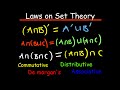
Set Theory Laws and Operations

Interactive Video
•
Mathematics
•
9th - 10th Grade
•
Practice Problem
•
Hard

Patricia Brown
FREE Resource
Read more
10 questions
Show all answers
1.
MULTIPLE CHOICE QUESTION
30 sec • 1 pt
What is the result of applying De Morgan's Law to the complement of a union of two sets?
The union of the complements of the sets
The complement of the intersection of the sets
The intersection of the complements of the sets
The complement of the union of the sets
2.
MULTIPLE CHOICE QUESTION
30 sec • 1 pt
In the example provided, what are the common elements in sets A and B?
3 and 4
0 and 2
2 and 4
1 and 3
3.
MULTIPLE CHOICE QUESTION
30 sec • 1 pt
What is the complement of the intersection of sets A and B in the example?
1, 3, and 4
0, 2, and 4
1, 2, and 4
0, 1, and 3
4.
MULTIPLE CHOICE QUESTION
30 sec • 1 pt
According to the Commutative Law, what is equivalent to A ∪ B?
A ∪ A
B ∪ A
A ∩ B
B ∩ A
5.
MULTIPLE CHOICE QUESTION
30 sec • 1 pt
Which of the following is an example of the Commutative Law in set theory?
A ∩ (B ∩ C) = (A ∩ B) ∩ C
A ∪ B = B ∪ A
A ∩ (B ∪ C) = (A ∩ B) ∪ (A ∩ C)
A ∪ (B ∪ C) = (A ∪ B) ∪ C
6.
MULTIPLE CHOICE QUESTION
30 sec • 1 pt
What does the Associative Law state about the grouping of operations?
The order of operations can be changed
The grouping of operations can be changed
The operations must be performed in sequence
The operations cannot be changed
7.
MULTIPLE CHOICE QUESTION
30 sec • 1 pt
Which of the following illustrates the Associative Law?
A ∪ (B ∩ C) = (A ∪ B) ∩ (A ∪ C)
A ∩ (B ∪ C) = (A ∩ B) ∪ (A ∩ C)
A ∪ (B ∪ C) = (A ∪ B) ∪ C
A ∩ (B ∩ C) = (A ∩ B) ∩ C
Access all questions and much more by creating a free account
Create resources
Host any resource
Get auto-graded reports

Continue with Google

Continue with Email

Continue with Classlink

Continue with Clever
or continue with

Microsoft
%20(1).png)
Apple

Others
Already have an account?

