
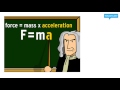
Newton's Laws of Motion Concepts

Interactive Video
•
Physics, Science, Mathematics
•
9th - 10th Grade
•
Practice Problem
•
Hard

Patricia Brown
FREE Resource
Read more
10 questions
Show all answers
1.
MULTIPLE CHOICE QUESTION
30 sec • 1 pt
What is the primary difference between speed and velocity?
Speed includes direction, velocity does not.
Velocity includes direction, speed does not.
Velocity is always greater than speed.
Speed is measured in m/s, velocity in km/h.
2.
MULTIPLE CHOICE QUESTION
30 sec • 1 pt
What happens to an object when an unbalanced force acts on it?
It remains at rest.
It moves at a constant speed.
It accelerates.
It decelerates.
3.
MULTIPLE CHOICE QUESTION
30 sec • 1 pt
What is the net force on an object when balanced forces act on it?
Equal to the sum of the forces.
Equal to the difference of the forces.
Equal to the product of the forces.
Zero.
4.
MULTIPLE CHOICE QUESTION
30 sec • 1 pt
According to Newton's First Law, what will happen to an object in motion if no external force acts on it?
It will continue moving at a constant speed.
It will stop immediately.
It will change direction.
It will accelerate.
5.
MULTIPLE CHOICE QUESTION
30 sec • 1 pt
What is inertia?
The tendency of an object to accelerate.
The force required to move an object.
The tendency of an object to resist changes in its state of motion.
The speed of an object in motion.
6.
MULTIPLE CHOICE QUESTION
30 sec • 1 pt
How is force calculated according to Newton's Second Law?
Force equals acceleration divided by mass.
Force equals mass divided by acceleration.
Force equals mass plus acceleration.
Force equals mass times acceleration.
7.
MULTIPLE CHOICE QUESTION
30 sec • 1 pt
If two objects are given the same force, which will have a greater acceleration?
The object with more mass.
The object with less mass.
Both will have the same acceleration.
The object with a larger surface area.
Access all questions and much more by creating a free account
Create resources
Host any resource
Get auto-graded reports

Continue with Google

Continue with Email

Continue with Classlink

Continue with Clever
or continue with

Microsoft
%20(1).png)
Apple

Others
Already have an account?

