
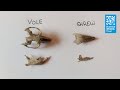
Owl Pellet Dissection Techniques

Interactive Video
•
Biology, Science, Other
•
5th - 6th Grade
•
Practice Problem
•
Hard

Patricia Brown
FREE Resource
Read more
10 questions
Show all answers
1.
MULTIPLE CHOICE QUESTION
30 sec • 1 pt
What is the primary composition of an owl pellet?
A compacted ball of fur and bones
A mixture of seeds and leaves
A collection of feathers and twigs
A mass of undigested food
2.
MULTIPLE CHOICE QUESTION
30 sec • 1 pt
Which tool is suggested for removing fluff from inside skulls during dissection?
Scissors
Mounted needles
A small brush
A knife
3.
MULTIPLE CHOICE QUESTION
30 sec • 1 pt
What is the purpose of using a magnifying glass during the dissection?
To clean the bones
To measure the pellet
To see fine details of the bones
To cut the pellet
4.
MULTIPLE CHOICE QUESTION
30 sec • 1 pt
What should you do if the owl pellet is very hard before starting the dissection?
Heat it gently
Soak it in water
Freeze it
Break it with a hammer
5.
MULTIPLE CHOICE QUESTION
30 sec • 1 pt
What is the first step in identifying what an owl has eaten?
Measuring the pellet
Counting the bones
Looking at the skulls
Examining the fur
6.
MULTIPLE CHOICE QUESTION
30 sec • 1 pt
How can you differentiate between vole and mouse teeth?
Mouse teeth have no roots
Vole teeth are smooth
Mouse teeth are larger
Vole teeth have grooves that run partway down
7.
MULTIPLE CHOICE QUESTION
30 sec • 1 pt
What is a common characteristic of shrew teeth?
They have no gap between front and back teeth
They are larger than rodent teeth
They are similar to rodent teeth
They have a gap between front and back teeth
Access all questions and much more by creating a free account
Create resources
Host any resource
Get auto-graded reports

Continue with Google

Continue with Email

Continue with Classlink

Continue with Clever
or continue with

Microsoft
%20(1).png)
Apple

Others
Already have an account?
Similar Resources on Wayground

6 questions
I WONDER - How Big Was The Quetzalcoatlus?
Interactive video
•
KG - 6th Grade
6 questions
High Five Facts - Fingers
Interactive video
•
KG - 6th Grade
6 questions
High Five Facts - Mouth
Interactive video
•
KG - 6th Grade
6 questions
I WONDER - What Did The Archaeopteryx Eat?
Interactive video
•
KG - 6th Grade
6 questions
CLEAN : Lebanon police rope off scene after crisis-linked suicide
Interactive video
•
6th - 7th Grade
6 questions
I WONDER - Do Sharks Have Bones?
Interactive video
•
3rd - 5th Grade
6 questions
I WONDER - Why Do Owls Have Funny Ears?
Interactive video
•
3rd - 5th Grade
6 questions
I WONDER - Why Do Owls Make Pellets? Me Pregunto - Por Qué Las Lechuzas Hacen Bolas De Pelos?
Interactive video
•
3rd - 5th Grade
Popular Resources on Wayground
15 questions
Fractions on a Number Line

Quiz
•
3rd Grade
20 questions
Equivalent Fractions
Quiz
•
3rd Grade
25 questions
Multiplication Facts
Quiz
•
5th Grade
29 questions
Alg. 1 Section 5.1 Coordinate Plane
Quiz
•
9th Grade
22 questions
fractions
Quiz
•
3rd Grade
11 questions
FOREST Effective communication

Lesson
•
KG
20 questions
Main Idea and Details
Quiz
•
5th Grade
20 questions
Context Clues
Quiz
•
6th Grade
Discover more resources for Biology
10 questions
Exploring Food Webs and Energy Pyramids
Interactive video
•
6th - 10th Grade
10 questions
Exploring the Impact of Genetic Mutations
Interactive video
•
6th - 10th Grade
5 questions
Inherited and Acquired Traits of Animals
Interactive video
•
4th Grade - University
16 questions
Chemical v. Physical Changes
Quiz
•
5th Grade
20 questions
Symbiotic Relationships - Ecology
Quiz
•
6th - 8th Grade
10 questions
Comparing Mitosis and Meiosis: Key Differences and Stages
Interactive video
•
6th - 10th Grade
28 questions
photosynthesis
Quiz
•
6th - 8th Grade
10 questions
Exploring Evidence of Evolution
Interactive video
•
6th - 10th Grade