
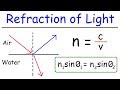
Refraction of Light and Snell's Law Explained

Interactive Video
•
Physics, Science, Mathematics
•
9th - 12th Grade
•
Practice Problem
•
Hard

Patricia Brown
FREE Resource
Read more
10 questions
Show all answers
1.
MULTIPLE CHOICE QUESTION
30 sec • 1 pt
What happens to a light ray when it strikes the boundary between two different media?
It can reflect, refract, or be absorbed.
It only reflects.
It always gets absorbed.
It only refracts.
2.
MULTIPLE CHOICE QUESTION
30 sec • 1 pt
What is the angle between the incident ray and the normal line called?
Angle of refraction
Critical angle
Angle of reflection
Angle of incidence
3.
MULTIPLE CHOICE QUESTION
30 sec • 1 pt
According to Snell's Law, what is the relationship between the angles of incidence and refraction?
They are inversely proportional.
They are related through the indices of refraction.
They are unrelated.
They are always equal.
4.
MULTIPLE CHOICE QUESTION
30 sec • 1 pt
What is the approximate index of refraction for water?
0.7071
1.0
2.4
1.33
5.
MULTIPLE CHOICE QUESTION
30 sec • 1 pt
How does the speed of light change when it enters a medium with a higher index of refraction?
It decreases.
It becomes zero.
It remains the same.
It increases.
6.
MULTIPLE CHOICE QUESTION
30 sec • 1 pt
What is the speed of light in a vacuum?
2.256 x 10^8 meters per second
0.7071 x 10^8 meters per second
3 x 10^8 meters per second
1.5 x 10^8 meters per second
7.
MULTIPLE CHOICE QUESTION
30 sec • 1 pt
What happens to light when it moves from a medium with a high index of refraction to a low one?
It bends towards the normal line.
It bends away from the normal line.
It travels in a straight line.
It gets absorbed completely.
Access all questions and much more by creating a free account
Create resources
Host any resource
Get auto-graded reports

Continue with Google

Continue with Email

Continue with Classlink

Continue with Clever
or continue with

Microsoft
%20(1).png)
Apple

Others
Already have an account?

