
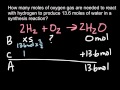
Mastering Stoichiometry Through BCA Tables and Chemical Reactions

Interactive Video
•
Chemistry, Science, Physics
•
9th - 12th Grade
•
Practice Problem
•
Hard

Patricia Brown
FREE Resource
Read more
10 questions
Show all answers
1.
MULTIPLE CHOICE QUESTION
30 sec • 1 pt
What does a balanced chemical equation tell us about the reactants and products?
The ratio of moles of reactants and products
The temperature at which the reaction occurs
The speed of the reaction
The exact number of molecules involved
2.
MULTIPLE CHOICE QUESTION
30 sec • 1 pt
In a BCA table, what does the 'B' stand for?
Base
Before
Bond
Balance
3.
MULTIPLE CHOICE QUESTION
30 sec • 1 pt
Why are mole ratios important in stoichiometry?
They provide the proportion of reactants and products
They determine the speed of the reaction
They help in measuring the temperature
They ensure the reaction is balanced
4.
MULTIPLE CHOICE QUESTION
30 sec • 1 pt
What is the first step in using a BCA table for a reaction?
Determine the temperature
Write a balanced chemical equation
Measure the volume of reactants
Calculate the speed of the reaction
5.
MULTIPLE CHOICE QUESTION
30 sec • 1 pt
In the example of hydrogen and oxygen reacting, how many moles of water are produced from 13.6 moles of hydrogen?
None of the above
13.6 moles
27.2 moles
6.8 moles
6.
MULTIPLE CHOICE QUESTION
30 sec • 1 pt
What assumption is made if the amount of a reactant is not specified in a BCA table?
It is in excess
It is limiting
It is not involved in the reaction
It is a catalyst
7.
MULTIPLE CHOICE QUESTION
30 sec • 1 pt
In the calcium chloride and silver nitrate reaction, what is the mole ratio of calcium chloride to silver nitrate?
2:2
1:1
1:2
2:1
Access all questions and much more by creating a free account
Create resources
Host any resource
Get auto-graded reports

Continue with Google

Continue with Email

Continue with Classlink

Continue with Clever
or continue with

Microsoft
%20(1).png)
Apple

Others
Already have an account?

