
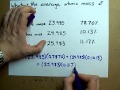
Calculating Average Atomic Mass Using Isotopic Abundances

Interactive Video
•
Chemistry, Mathematics, Science
•
9th - 12th Grade
•
Practice Problem
•
Hard

Patricia Brown
FREE Resource
Read more
8 questions
Show all answers
1.
MULTIPLE CHOICE QUESTION
30 sec • 1 pt
What is the first step in calculating the average atomic mass of an element?
Multiply each isotopic mass by its abundance.
Add all isotopic masses together.
Convert isotopic masses to percentages.
Divide the total mass by the number of isotopes.
2.
MULTIPLE CHOICE QUESTION
30 sec • 1 pt
How should you express isotopic abundances when calculating average atomic mass?
As decimals.
As percentages.
As fractions.
As whole numbers.
3.
MULTIPLE CHOICE QUESTION
30 sec • 1 pt
What is the isotopic abundance of Magnesium-24 in decimal form?
0.7870
0.1013
0.1117
0.2430
4.
MULTIPLE CHOICE QUESTION
30 sec • 1 pt
Which of the following is NOT a step in calculating the average atomic mass?
Multiply each isotopic mass by its abundance.
Add the results of all isotopes together.
Convert the final result to a percentage.
Use a calculator to sum the products.
5.
MULTIPLE CHOICE QUESTION
30 sec • 1 pt
What is the calculated average atomic mass of magnesium from the example?
24.309 amu
24.985 amu
25.983 amu
23.985 amu
6.
MULTIPLE CHOICE QUESTION
30 sec • 1 pt
What unit is typically used for average atomic mass?
liters
grams
amu
kilograms
7.
MULTIPLE CHOICE QUESTION
30 sec • 1 pt
How can you verify your calculated average atomic mass?
By using a different calculation method.
By comparing it with the molar mass on the periodic table.
By checking with a chemistry textbook.
By asking a teacher.
Access all questions and much more by creating a free account
Create resources
Host any resource
Get auto-graded reports

Continue with Google

Continue with Email

Continue with Classlink

Continue with Clever
or continue with

Microsoft
%20(1).png)
Apple

Others
Already have an account?


