
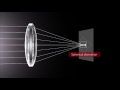
The Science Behind Convex Lenses And Image Formation

Interactive Video
•
Physics, Science, Other
•
9th - 10th Grade
•
Practice Problem
•
Hard

Patricia Brown
FREE Resource
Read more
10 questions
Show all answers
1.
MULTIPLE CHOICE QUESTION
30 sec • 1 pt
What happens to an image when viewed through a single convex lens?
It appears right-side up.
It appears upside down.
It appears smaller.
It appears larger.
2.
MULTIPLE CHOICE QUESTION
30 sec • 1 pt
What is the term for the bending of light as it passes through a lens?
Dispersion
Diffraction
Reflection
Refraction
3.
MULTIPLE CHOICE QUESTION
30 sec • 1 pt
Why can't a spherical convex lens alone produce a sharp image?
Because it reflects light.
Because it absorbs light.
Because of spherical aberration.
Because of chromatic aberration.
4.
MULTIPLE CHOICE QUESTION
30 sec • 1 pt
What is spherical aberration?
A phenomenon where light rays do not converge to a single point.
A process that makes images appear larger.
A type of lens distortion that affects color.
A method to correct lens imperfections.
5.
MULTIPLE CHOICE QUESTION
30 sec • 1 pt
What causes chromatic aberration in lenses?
Light rays reflecting off the lens surface.
Light rays bending outward.
Light rays converging to a single point.
Different wavelengths of light focusing at different points.
6.
MULTIPLE CHOICE QUESTION
30 sec • 1 pt
How can chromatic aberration be corrected?
By using a single lens.
By using a concave lens.
By combining two lenses.
By increasing the lens thickness.
7.
MULTIPLE CHOICE QUESTION
30 sec • 1 pt
What is the purpose of aberration correction in lenses?
To make lenses more durable.
To make light converge neatly to a single point.
To make lenses lighter.
To make lenses cheaper.
Access all questions and much more by creating a free account
Create resources
Host any resource
Get auto-graded reports

Continue with Google

Continue with Email

Continue with Classlink

Continue with Clever
or continue with

Microsoft
%20(1).png)
Apple

Others
Already have an account?

