
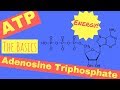
The Energy Currency of Cells: Exploring ATP and Its Role in Living Organisms

Interactive Video
•
Biology, Science, Chemistry
•
9th - 10th Grade
•
Practice Problem
•
Hard

Patricia Brown
FREE Resource
Read more
7 questions
Show all answers
1.
MULTIPLE CHOICE QUESTION
30 sec • 1 pt
What are the three main components that make up ATP?
Guanine, glucose, and two phosphates
Cytosine, ribose, and three phosphates
Adenine, ribose, and three phosphates
Adenine, glucose, and two phosphates
2.
MULTIPLE CHOICE QUESTION
30 sec • 1 pt
What happens to ATP when it loses a phosphate group?
It becomes glucose
It becomes ADP
It becomes a protein
It becomes AMP
3.
MULTIPLE CHOICE QUESTION
30 sec • 1 pt
What is the primary source of energy for all living organisms?
Water
Oxygen
The sun
Carbon dioxide
4.
MULTIPLE CHOICE QUESTION
30 sec • 1 pt
In which part of the plant cell is ATP produced during photosynthesis?
Ribosome
Nucleus
Mitochondria
Chloroplast
5.
MULTIPLE CHOICE QUESTION
30 sec • 1 pt
How do animal cells primarily produce ATP?
Through photosynthesis
By breaking down glucose
By absorbing sunlight
Through fermentation
6.
MULTIPLE CHOICE QUESTION
30 sec • 1 pt
Where does most of the ATP production occur in animal cells?
Nucleus
Chloroplast
Ribosome
Mitochondria
7.
MULTIPLE CHOICE QUESTION
30 sec • 1 pt
What is the relationship between ATP and ADP in terms of energy?
ATP is a low energy compound, ADP is high energy
Both ATP and ADP are high energy compounds
Both ATP and ADP are low energy compounds
ATP is a high energy compound, ADP is low energy
Access all questions and much more by creating a free account
Create resources
Host any resource
Get auto-graded reports

Continue with Google

Continue with Email

Continue with Microsoft
or continue with

%20(1).png)
Apple

Others
Already have an account?



