
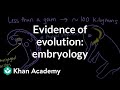
Embryonic Evolution and Homologous Features in Vertebrates

Interactive Video
•
Biology, Science, Other
•
6th - 8th Grade
•
Practice Problem
•
Hard

Patricia Brown
FREE Resource
Read more
10 questions
Show all answers
1.
MULTIPLE CHOICE QUESTION
30 sec • 1 pt
What is an embryo?
A mature animal
A type of plant seed
An organism in its earliest stages of development
A fully developed organism
2.
MULTIPLE CHOICE QUESTION
30 sec • 1 pt
What happens to the embryonic tail in humans?
It disappears completely
It remains visible throughout life
It transforms into the tailbone
It becomes a part of the brain
3.
MULTIPLE CHOICE QUESTION
30 sec • 1 pt
Which of the following is an example of a homologous feature?
Wings of a butterfly and a bat
Embryo tails in vertebrates
Leaves of different plants
Fins of a fish and a dolphin
4.
MULTIPLE CHOICE QUESTION
30 sec • 1 pt
Why are homologous features important to scientists?
They show differences in diet
They predict future evolution
They indicate a common ancestor between species
They help identify new species
5.
MULTIPLE CHOICE QUESTION
30 sec • 1 pt
What is the significance of studying embryos in evolutionary biology?
To find differences in adult animals
To identify similarities not visible in adults
To classify plants
To study non-living organisms
6.
MULTIPLE CHOICE QUESTION
30 sec • 1 pt
What is a significant change in an elephant embryo during development?
It grows a long tail
It develops pharyngeal arches
It loses its backbone
It becomes a different species
7.
MULTIPLE CHOICE QUESTION
30 sec • 1 pt
What is the birth weight of an elephant embryo?
Less than a gram
About 100 kilograms
Over 200 kilograms
About 10 kilograms
Access all questions and much more by creating a free account
Create resources
Host any resource
Get auto-graded reports

Continue with Google

Continue with Email

Continue with Classlink

Continue with Clever
or continue with

Microsoft
%20(1).png)
Apple

Others
Already have an account?

