
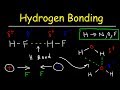
Understanding Hydrogen Bonds

Interactive Video
•
Chemistry, Science
•
9th - 12th Grade
•
Practice Problem
•
Hard

Aiden Montgomery
FREE Resource
Read more
10 questions
Show all answers
1.
MULTIPLE CHOICE QUESTION
30 sec • 1 pt
What type of interaction is a hydrogen bond?
Metallic interaction
Ionic interaction
Covalent interaction
Dipole-dipole interaction
2.
MULTIPLE CHOICE QUESTION
30 sec • 1 pt
Which of the following elements can form hydrogen bonds with hydrogen?
Chlorine
Oxygen
Carbon
Sulfur
3.
MULTIPLE CHOICE QUESTION
30 sec • 1 pt
Why are hydrogen bonds stronger than typical dipole-dipole interactions?
Hydrogen bonds are ionic in nature
Hydrogen bonds involve larger atoms
Hydrogen bonds are highly polarized and involve small atoms
Hydrogen bonds have smaller electronegativity differences
4.
MULTIPLE CHOICE QUESTION
30 sec • 1 pt
What happens to the electrostatic force of attraction when the distance between two charges is halved?
It halves
It remains the same
It quadruples
It doubles
5.
MULTIPLE CHOICE QUESTION
30 sec • 1 pt
In the context of hydrogen bonds, what does 'intermolecular' mean?
Within a single atom
Within a single molecule
Between different atoms
Between different molecules
6.
MULTIPLE CHOICE QUESTION
30 sec • 1 pt
What is the role of hydrogen bonds in the structure of water?
They repel water molecules from each other
They hold water molecules together through intermolecular forces
They create ionic bonds between water molecules
They form covalent bonds within water molecules
7.
MULTIPLE CHOICE QUESTION
30 sec • 1 pt
What is the enthalpy of vaporization for water?
23 kJ/mol
934 kJ/mol
40.7 kJ/mol
467 kJ/mol
Access all questions and much more by creating a free account
Create resources
Host any resource
Get auto-graded reports

Continue with Google

Continue with Email

Continue with Classlink

Continue with Clever
or continue with

Microsoft
%20(1).png)
Apple

Others
Already have an account?

