
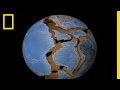
Understanding Earthquakes

Interactive Video
•
Science, Geography
•
6th - 10th Grade
•
Practice Problem
•
Easy

Olivia Brooks
Used 1+ times
FREE Resource
Read more
9 questions
Show all answers
1.
MULTIPLE CHOICE QUESTION
30 sec • 1 pt
Why are earthquakes considered particularly frightening?
They only happen in remote areas.
They can be predicted accurately.
They are always followed by tsunamis.
They occur without any warning.
2.
MULTIPLE CHOICE QUESTION
30 sec • 1 pt
Where do most small earthquakes occur?
On the surface of the ocean.
Along the boundaries of tectonic plates.
In the middle of tectonic plates.
In the Earth's core.
3.
MULTIPLE CHOICE QUESTION
30 sec • 1 pt
What happens when the motion of tectonic plates is blocked?
The plates stop moving permanently.
Stress builds up until the fault gives way.
The plates melt and form magma.
The Earth's core cools down.
4.
MULTIPLE CHOICE QUESTION
30 sec • 1 pt
What is released when a fault gives way?
Volcanic lava
Seismic waves
Ocean currents
Atmospheric pressure
5.
MULTIPLE CHOICE QUESTION
30 sec • 1 pt
What is the role of seismic waves in an earthquake?
They cause the Earth's core to cool.
They are the energy released during an earthquake.
They prevent earthquakes from occurring.
They are used to predict future earthquakes.
6.
MULTIPLE CHOICE QUESTION
30 sec • 1 pt
How do earthquakes contribute to Earth's topography?
They dry up oceans.
They cause continents to drift apart.
They flatten mountains.
They create valleys and mountains.
7.
MULTIPLE CHOICE QUESTION
30 sec • 1 pt
What would Earth be like without the flow of heat from its interior?
A cold, dead place like the moon
Covered entirely in water
A vibrant and warm planet
Constantly experiencing volcanic eruptions
Access all questions and much more by creating a free account
Create resources
Host any resource
Get auto-graded reports

Continue with Google

Continue with Email

Continue with Classlink

Continue with Clever
or continue with

Microsoft
%20(1).png)
Apple

Others
Already have an account?


