
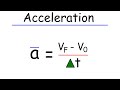
Understanding Acceleration

Interactive Video
•
Physics, Science
•
9th - 12th Grade
•
Practice Problem
•
Hard

Liam Anderson
FREE Resource
Read more
10 questions
Show all answers
1.
MULTIPLE CHOICE QUESTION
30 sec • 1 pt
What happens to acceleration when an object's velocity is decreasing?
Acceleration remains constant
Acceleration becomes negative
Acceleration becomes zero
Acceleration becomes positive
2.
MULTIPLE CHOICE QUESTION
30 sec • 1 pt
Which type of acceleration is calculated using the formula: final velocity minus initial velocity divided by time?
Instantaneous acceleration
Constant acceleration
Average acceleration
Centripetal acceleration
3.
MULTIPLE CHOICE QUESTION
30 sec • 1 pt
In a velocity-time graph, what does the slope of the tangent line represent?
Average acceleration
Average velocity
Instantaneous velocity
Instantaneous acceleration
4.
MULTIPLE CHOICE QUESTION
30 sec • 1 pt
A car accelerates from 10 m/s to 30 m/s in 4 seconds. What is its average acceleration?
10 m/s²
2.5 m/s²
5 m/s²
7.5 m/s²
5.
MULTIPLE CHOICE QUESTION
30 sec • 1 pt
A bus accelerates from 15 m/s to 45 m/s over a distance of 400 meters. What is its average acceleration?
4.0 m/s²
3.0 m/s²
2.25 m/s²
1.5 m/s²
6.
MULTIPLE CHOICE QUESTION
30 sec • 1 pt
What is the average acceleration of a particle described by the function v(t) = t³ - 4t² + 5 between t = 2 and t = 4 seconds?
5 ft/s²
4 ft/s²
3 ft/s²
2 ft/s²
7.
MULTIPLE CHOICE QUESTION
30 sec • 1 pt
How can you estimate instantaneous acceleration using average acceleration?
By using a different formula
By keeping the time interval constant
By decreasing the time interval
By increasing the time interval
Access all questions and much more by creating a free account
Create resources
Host any resource
Get auto-graded reports

Continue with Google

Continue with Email

Continue with Classlink

Continue with Clever
or continue with

Microsoft
%20(1).png)
Apple

Others
Already have an account?

