
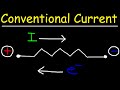
Understanding Conventional Current and Electron Flow

Interactive Video
•
Physics, Science
•
9th - 12th Grade
•
Practice Problem
•
Hard

Aiden Montgomery
FREE Resource
Read more
10 questions
Show all answers
1.
MULTIPLE CHOICE QUESTION
30 sec • 1 pt
What is the direction of conventional current in a resistor with a potential difference from 20 volts to 15 volts?
No flow
Both directions
From 20 volts to 15 volts
From 15 volts to 20 volts
2.
MULTIPLE CHOICE QUESTION
30 sec • 1 pt
What is the potential difference across a resistor if one side is at 20 volts and the other at 15 volts?
5 volts
20 volts
35 volts
15 volts
3.
MULTIPLE CHOICE QUESTION
30 sec • 1 pt
In metal wires, which particles are responsible for the actual movement of charge?
Electrons
Neutrons
Protons
Ions
4.
MULTIPLE CHOICE QUESTION
30 sec • 1 pt
How do electrons move in a circuit with a battery?
They do not move
In a circular path
From negative to positive
From positive to negative
5.
MULTIPLE CHOICE QUESTION
30 sec • 1 pt
What happens to a proton placed in an electric field between two parallel plates?
It moves towards the positive plate
It moves towards the negative plate
It remains stationary
It moves in a circular path
6.
MULTIPLE CHOICE QUESTION
30 sec • 1 pt
How do negative charges behave in an electric field?
They move towards the positive plate
They move towards the negative plate
They remain stationary
They move in a circular path
7.
MULTIPLE CHOICE QUESTION
30 sec • 1 pt
What is the main difference between conventional current and electron flow?
Conventional current is faster
They move in the same direction
They move in opposite directions
Electron flow is slower
Access all questions and much more by creating a free account
Create resources
Host any resource
Get auto-graded reports

Continue with Google

Continue with Email

Continue with Classlink

Continue with Clever
or continue with

Microsoft
%20(1).png)
Apple

Others
Already have an account?

