
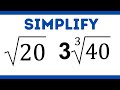
Simplifying Radicals and Roots

Interactive Video
•
Mathematics, Science
•
6th - 9th Grade
•
Practice Problem
•
Easy

Aiden Montgomery
Used 3+ times
FREE Resource
Read more
10 questions
Show all answers
1.
MULTIPLE CHOICE QUESTION
30 sec • 1 pt
What is the first step in simplifying radicals using a factor tree?
Identify and circle all prime numbers.
Subtract 1 from the number.
Multiply all numbers together.
Divide the number by 3.
2.
MULTIPLE CHOICE QUESTION
30 sec • 1 pt
When simplifying the square root of 20, what is the result after using a factor tree?
5 square root 2
3 square root 5
2 square root 5
4 square root 5
3.
MULTIPLE CHOICE QUESTION
30 sec • 1 pt
What is the purpose of circling numbers in a factor tree?
To indicate numbers to be subtracted.
To highlight prime numbers.
To mark numbers that need to be multiplied.
To identify composite numbers.
4.
MULTIPLE CHOICE QUESTION
30 sec • 1 pt
What remains inside the radical sign after simplifying the square root of 20?
2
10
5
1
5.
MULTIPLE CHOICE QUESTION
30 sec • 1 pt
What is the simplified form of the square root of 250?
5 square root 2
2 square root 25
10 square root 5
5 square root 10
6.
MULTIPLE CHOICE QUESTION
30 sec • 1 pt
How do you determine which numbers go outside the radical sign when simplifying?
By subtracting the smallest number.
By finding pairs or triplets of prime numbers.
By dividing by the largest number.
By adding all numbers together.
7.
MULTIPLE CHOICE QUESTION
30 sec • 1 pt
What is the key difference between simplifying square roots and cube roots?
Both use triplets.
Square roots use triplets, cube roots use pairs.
Square roots use pairs, cube roots use triplets.
Both use pairs.
Access all questions and much more by creating a free account
Create resources
Host any resource
Get auto-graded reports

Continue with Google

Continue with Email

Continue with Classlink

Continue with Clever
or continue with

Microsoft
%20(1).png)
Apple

Others
Already have an account?

