
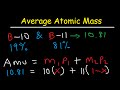
Understanding Average Atomic Mass and Isotope Abundance

Interactive Video
•
Chemistry, Science
•
9th - 12th Grade
•
Practice Problem
•
Easy

Emma Peterson
Used 20+ times
FREE Resource
Read more
10 questions
Show all answers
1.
MULTIPLE CHOICE QUESTION
30 sec • 1 pt
What is the average atomic mass of boron if the isotopes B-10 and B-11 have relative abundances of 19% and 81% respectively?
10.00
10.81
11.00
9.81
2.
MULTIPLE CHOICE QUESTION
30 sec • 1 pt
If the average atomic mass of boron is 10.81, what is the relative abundance of B-10?
81%
19%
100%
50%
3.
MULTIPLE CHOICE QUESTION
30 sec • 1 pt
Given the average atomic mass of chlorine is 35.45, what is the relative abundance of Cl-35?
77.5%
100%
50%
22.5%
4.
MULTIPLE CHOICE QUESTION
30 sec • 1 pt
Why is the average atomic mass of chlorine closer to 35 than 37?
Cl-35 is more abundant
Both isotopes are equally abundant
Cl-37 is more abundant
The atomic mass is not a weighted average
5.
MULTIPLE CHOICE QUESTION
30 sec • 1 pt
What is the average atomic mass of silicon given the isotopes Si-28, Si-29, and Si-30 with relative abundances of 92.23%, 4.68%, and 3.09% respectively?
27.00
30.00
29.00
28.11
6.
MULTIPLE CHOICE QUESTION
30 sec • 1 pt
How does the presence of more isotopes affect the calculation of average atomic mass?
It always results in a higher average mass
It simplifies the calculation
It has no effect
It makes the calculation more complex
7.
MULTIPLE CHOICE QUESTION
30 sec • 1 pt
What is the main challenge when calculating the relative percent abundance with three isotopes?
Converting percentages to decimals
Solving multiple equations
Identifying the isotopes
Finding the mass of each isotope
Access all questions and much more by creating a free account
Create resources
Host any resource
Get auto-graded reports

Continue with Google

Continue with Email

Continue with Classlink

Continue with Clever
or continue with

Microsoft
%20(1).png)
Apple

Others
Already have an account?


