
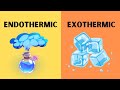
Understanding Endothermic and Exothermic Phase Changes

Interactive Video
•
Physics, Chemistry, Science
•
6th - 9th Grade
•
Practice Problem
•
Medium

Liam Anderson
Used 6+ times
FREE Resource
Read more
9 questions
Show all answers
1.
MULTIPLE CHOICE QUESTION
30 sec • 1 pt
What is a phase change in terms of states of matter?
A change from one chemical to another
A change from one state of matter to another
A change in temperature without state change
A change in color of a substance
2.
MULTIPLE CHOICE QUESTION
30 sec • 1 pt
Which of the following is an example of an endothermic phase change?
Deposition
Condensation
Freezing
Melting
3.
MULTIPLE CHOICE QUESTION
30 sec • 1 pt
What happens to the temperature of the surroundings during an endothermic phase change?
It fluctuates
It increases
It remains constant
It decreases
4.
MULTIPLE CHOICE QUESTION
30 sec • 1 pt
Which phase change is characterized by the release of heat to the surroundings?
Melting
Condensation
Vaporization
Sublimation
5.
MULTIPLE CHOICE QUESTION
30 sec • 1 pt
What is the result of an exothermic phase change on the surrounding temperature?
The temperature decreases
The temperature increases
The temperature remains the same
The temperature fluctuates
6.
MULTIPLE CHOICE QUESTION
30 sec • 1 pt
Which of the following is NOT an exothermic phase change?
Vaporization
Deposition
Condensation
Freezing
7.
MULTIPLE CHOICE QUESTION
30 sec • 1 pt
How can you remember the difference between endothermic and exothermic changes?
Exothermic means heat remains constant
Endothermic means heat enters
Exothermic means heat enters
Endothermic means heat exits
Access all questions and much more by creating a free account
Create resources
Host any resource
Get auto-graded reports

Continue with Google

Continue with Email

Continue with Classlink

Continue with Clever
or continue with

Microsoft
%20(1).png)
Apple

Others
Already have an account?

