
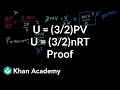
Understanding Internal Energy and Ideal Gases

Interactive Video
•
Physics, Chemistry, Science
•
10th - 12th Grade
•
Practice Problem
•
Hard

Emma Peterson
FREE Resource
Read more
10 questions
Show all answers
1.
MULTIPLE CHOICE QUESTION
30 sec • 1 pt
What does the internal energy of a system include?
Only kinetic energy
Only potential energy
Only chemical energy
Kinetic, potential, and chemical energy
2.
MULTIPLE CHOICE QUESTION
30 sec • 1 pt
In the context of an ideal monoatomic gas, what is the internal energy primarily composed of?
Thermal energy
Kinetic energy
Chemical energy
Potential energy
3.
MULTIPLE CHOICE QUESTION
30 sec • 1 pt
What simplification is made in the thought experiment involving a cube?
Particles are stationary
Particles move parallel to each axis
Particles move randomly in all directions
Particles move in a circular path
4.
MULTIPLE CHOICE QUESTION
30 sec • 1 pt
How is force related to momentum in the context of a single particle hitting a wall?
Force is independent of momentum
Force is the product of momentum and time
Force is the sum of momentum and time
Force is the change in momentum over time
5.
MULTIPLE CHOICE QUESTION
30 sec • 1 pt
What is the formula for the pressure exerted by a single particle on a wall?
mv^2 over x
mv^2 over x^4
mv^2 over x^2
mv^2 over x^3
6.
MULTIPLE CHOICE QUESTION
30 sec • 1 pt
How is the total pressure on a wall calculated in the cube model?
By considering one-third of the particles
By considering only particles moving parallel to the wall
By considering all particles moving randomly
By considering half of the particles
7.
MULTIPLE CHOICE QUESTION
30 sec • 1 pt
What does the formula 3/2 pv represent in the context of the system?
Total thermal energy
Total potential energy
Total chemical energy
Total kinetic energy
Access all questions and much more by creating a free account
Create resources
Host any resource
Get auto-graded reports

Continue with Google

Continue with Email

Continue with Classlink

Continue with Clever
or continue with

Microsoft
%20(1).png)
Apple

Others
Already have an account?

