
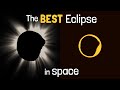
Eclipses in the Solar System

Interactive Video
•
Science, Physics
•
7th - 12th Grade
•
Practice Problem
•
Hard

Lucas Foster
FREE Resource
Read more
10 questions
Show all answers
1.
MULTIPLE CHOICE QUESTION
30 sec • 1 pt
What is the primary reason that solar eclipses on Earth are considered impressive?
The moon is much larger than the sun.
The moon and sun appear similarly sized in the sky.
Eclipses occur frequently on Earth.
The sun's corona is never visible.
2.
MULTIPLE CHOICE QUESTION
30 sec • 1 pt
Why are there no solar eclipses on Mercury and Venus?
They are too far from the sun.
They have no moons.
They are too close to the sun.
Their atmospheres are too thick.
3.
MULTIPLE CHOICE QUESTION
30 sec • 1 pt
Which moon of Mars can cover up to 30% of the sun during an eclipse?
Io
Phobos
Deimos
Ganymede
4.
MULTIPLE CHOICE QUESTION
30 sec • 1 pt
What makes Callisto's eclipses on Jupiter unique compared to other moons?
They occur every day.
They are invisible from Jupiter.
They allow viewing of the sun's corona and 360° sunrise.
They are the largest eclipses in the solar system.
5.
MULTIPLE CHOICE QUESTION
30 sec • 1 pt
Which moons of Saturn are known to create both total and annular eclipses?
Titan and Rhea
Mimas and Enceladus
Pandora and Prometheus
Hyperion and Helene
6.
MULTIPLE CHOICE QUESTION
30 sec • 1 pt
What effect does the 'sunrise shrinking effect' have on eclipses?
It only affects eclipses on Earth.
It increases the duration of eclipses.
It causes moons to appear smaller at sunrise or sunset.
It makes the sun appear larger.
7.
MULTIPLE CHOICE QUESTION
30 sec • 1 pt
Why are eclipses on Uranus generally less impressive?
The sun appears as a small point in the sky.
Uranus has no moons.
The atmosphere is too thick.
Eclipses occur too frequently.
Access all questions and much more by creating a free account
Create resources
Host any resource
Get auto-graded reports

Continue with Google

Continue with Email

Continue with Classlink

Continue with Clever
or continue with

Microsoft
%20(1).png)
Apple

Others
Already have an account?


