
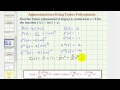
Understanding Taylor and Maclaurin Polynomials

Interactive Video
•
Mathematics
•
10th - 12th Grade
•
Practice Problem
•
Hard
Standards-aligned

Lucas Foster
FREE Resource
Standards-aligned
Read more
10 questions
Show all answers
1.
MULTIPLE CHOICE QUESTION
30 sec • 1 pt
What is the main goal of finding a Taylor polynomial in this tutorial?
To approximate the function f(x) = ln(1 + x) using a polynomial.
To solve differential equations.
To determine the maximum value of f(x) = ln(1 + x).
To find the exact value of f(x) = ln(1 + x).
2.
MULTIPLE CHOICE QUESTION
30 sec • 1 pt
What is the first derivative of f(x) = ln(1 + x)?
ln(x)
1 + x
x / (1 + x)
1 / (1 + x)
3.
MULTIPLE CHOICE QUESTION
30 sec • 1 pt
How is the second derivative of f(x) = ln(1 + x) expressed?
1 / (1 + x)^2
x^2 / (1 + x)
-1 / (1 + x)^2
-x / (1 + x)^2
4.
MULTIPLE CHOICE QUESTION
30 sec • 1 pt
What is the value of the third derivative of f(x) = ln(1 + x) at x = 0?
-1
1
-2
2
5.
MULTIPLE CHOICE QUESTION
30 sec • 1 pt
What is the coefficient of the x^3 term in the Maclaurin polynomial?
1/3
1/4
1/2
1/6
6.
MULTIPLE CHOICE QUESTION
30 sec • 1 pt
How is the error in the Taylor polynomial approximation estimated?
Using the Taylor remainder theorem.
By calculating the exact value of the function.
By using numerical integration.
By comparing with a different polynomial.
Tags
CCSS.HSF.BF.B.3
7.
MULTIPLE CHOICE QUESTION
30 sec • 1 pt
What is the maximum value of the fifth derivative of f(x) = ln(1 + x) on the interval considered?
12
48
24
6
Access all questions and much more by creating a free account
Create resources
Host any resource
Get auto-graded reports

Continue with Google

Continue with Email

Continue with Classlink

Continue with Clever
or continue with

Microsoft
%20(1).png)
Apple

Others
Already have an account?

