
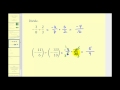
Understanding Multiplication and Division of Fractions

Interactive Video
•
Mathematics
•
6th - 8th Grade
•
Practice Problem
•
Hard
+1
Standards-aligned

Ethan Morris
FREE Resource
Standards-aligned
Read more
10 questions
Show all answers
1.
MULTIPLE CHOICE QUESTION
30 sec • 1 pt
What is the first step in dividing two fractions?
Add the fractions
Multiply by the reciprocal of the divisor
Subtract the fractions
Divide the numerators
2.
MULTIPLE CHOICE QUESTION
30 sec • 1 pt
When dividing -3 by 1/12, what is the reciprocal of 1/12?
1/2
2
1/12
12
Tags
CCSS.7.NS.A.2C
3.
MULTIPLE CHOICE QUESTION
30 sec • 1 pt
What is the importance of moving the negative sign to the numerator?
To change the fraction's value
To simplify tracking of signs
To make the fraction positive
To make calculations easier
Tags
CCSS.5.NF.B.6
4.
MULTIPLE CHOICE QUESTION
30 sec • 1 pt
Why is it important to simplify fractions before multiplying?
To reduce calculation errors
To make the numbers larger
To make the process faster
To ensure the result is in simplest form
Tags
CCSS.7.NS.A.2A
CCSS.7.NS.A.2B
5.
MULTIPLE CHOICE QUESTION
30 sec • 1 pt
What is the result of multiplying -1 by -5?
-5
5
-1
0
Tags
CCSS.7.NS.A.2A
CCSS.7.NS.A.2B
6.
MULTIPLE CHOICE QUESTION
30 sec • 1 pt
What is the prime factorization of 10?
5 * 5
3 * 3
2 * 5
2 * 2
7.
MULTIPLE CHOICE QUESTION
30 sec • 1 pt
How can prime factorization help in simplifying fractions?
By changing the signs
By adding more steps
By identifying common factors
By making the numbers larger
Access all questions and much more by creating a free account
Create resources
Host any resource
Get auto-graded reports

Continue with Google

Continue with Email

Continue with Microsoft
or continue with

%20(1).png)
Apple

Others
Already have an account?

