
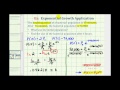
Exponential Growth and Population Dynamics

Interactive Video
•
Mathematics, Biology, Science
•
9th - 12th Grade
•
Practice Problem
•
Hard

Amelia Wright
FREE Resource
Read more
10 questions
Show all answers
1.
MULTIPLE CHOICE QUESTION
30 sec • 1 pt
What is the doubling period of the bacterial population mentioned in the video?
10 minutes
20 minutes
15 minutes
30 minutes
2.
MULTIPLE CHOICE QUESTION
30 sec • 1 pt
Which form of the exponential function is used in the video to model the bacterial population?
P(t) = P0 * B^t
P(t) = A * B^t
P(t) = P0 * e^(kt)
P(t) = A * e^(kt)
3.
MULTIPLE CHOICE QUESTION
30 sec • 1 pt
What does the variable 'k' represent in the exponential function used in the video?
Time in minutes
Continuous growth rate
Doubling period
Initial population
4.
MULTIPLE CHOICE QUESTION
30 sec • 1 pt
How is the continuous growth rate 'k' calculated in the video?
By dividing the natural log of 2 by 15
By multiplying the natural log of 2 by 15
By dividing the natural log of 15 by 2
By multiplying the natural log of 15 by 2
5.
MULTIPLE CHOICE QUESTION
30 sec • 1 pt
What is the approximate value of 'k' calculated in the video?
0.046210
0.062410
0.032110
0.056210
6.
MULTIPLE CHOICE QUESTION
30 sec • 1 pt
What is the initial population of bacteria determined in the video?
2,250 bacteria
1,500 bacteria
4,500 bacteria
3,000 bacteria
7.
MULTIPLE CHOICE QUESTION
30 sec • 1 pt
How is the initial population calculated using the given population after 75 minutes?
By multiplying 72,000 by e^(0.046210 * 75)
By dividing 72,000 by e^(0.046210 * 75)
By subtracting 72,000 from e^(0.046210 * 75)
By adding 72,000 to e^(0.046210 * 75)
Access all questions and much more by creating a free account
Create resources
Host any resource
Get auto-graded reports

Continue with Google

Continue with Email

Continue with Classlink

Continue with Clever
or continue with

Microsoft
%20(1).png)
Apple

Others
Already have an account?

