
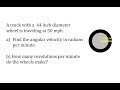
Understanding Angular Velocity and Revolutions

Interactive Video
•
Mathematics, Physics
•
9th - 12th Grade
•
Practice Problem
•
Hard

Liam Anderson
FREE Resource
Read more
10 questions
Show all answers
1.
MULTIPLE CHOICE QUESTION
30 sec • 1 pt
What is the first step in solving the problem of finding angular velocity and revolutions per minute for a truck's wheel?
Convert the wheel's diameter to meters
Find the radius from the diameter
Determine the wheel's circumference
Calculate the truck's speed in kilometers per hour
2.
MULTIPLE CHOICE QUESTION
30 sec • 1 pt
How is linear velocity related to angular velocity and radius?
Linear velocity is the sum of angular velocity and radius
Linear velocity is the product of angular velocity and radius
Linear velocity is the difference between angular velocity and radius
Linear velocity is the quotient of angular velocity and radius
3.
MULTIPLE CHOICE QUESTION
30 sec • 1 pt
Why is it important to understand the relationship between linear and angular velocity?
To convert units of measurement
To find the distance traveled by a rotating object
To determine the time taken for a journey
To calculate the speed of a vehicle
4.
MULTIPLE CHOICE QUESTION
30 sec • 1 pt
What is the purpose of converting miles per hour to inches per minute in this problem?
To simplify the calculation of the truck's speed
To match the units of radius for calculating angular velocity
To find the circumference of the wheel
To determine the time taken for one revolution
5.
MULTIPLE CHOICE QUESTION
30 sec • 1 pt
Which unit fraction is used to convert feet to inches?
5280 feet / 1 mile
1 mile / 5280 feet
12 inches / 1 foot
1 foot / 12 inches
6.
MULTIPLE CHOICE QUESTION
30 sec • 1 pt
What is the angular velocity in radians per minute if the linear velocity is 52,800 inches per minute and the radius is 22 inches?
5,280 radians per minute
1,200 radians per minute
22 radians per minute
2,400 radians per minute
7.
MULTIPLE CHOICE QUESTION
30 sec • 1 pt
How do you calculate the angular velocity from linear velocity and radius?
Subtract radius from linear velocity
Multiply linear velocity by radius
Divide linear velocity by radius
Add linear velocity to radius
Access all questions and much more by creating a free account
Create resources
Host any resource
Get auto-graded reports

Continue with Google

Continue with Email

Continue with Classlink

Continue with Clever
or continue with

Microsoft
%20(1).png)
Apple

Others
Already have an account?


