
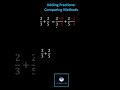
Understanding Fraction Addition

Interactive Video
•
Mathematics, English, World Languages, Physics, Chemistry, Biology, Science, Geography, History, Arts, Social Studies, Computers, Physical Ed, Fun, Professional Development, Architecture, Business, Design, Education, Instructional Technology, Journalism, Life Skills, Moral Science, Philosophy, Performing Arts, Religious Studies, Special Education, Specialty, Other
•
4th - 8th Grade
•
Practice Problem
•
Hard
+3
Standards-aligned

Aiden Montgomery
FREE Resource
Standards-aligned
Read more
5 questions
Show all answers
1.
MULTIPLE CHOICE QUESTION
30 sec • 1 pt
What is the least common denominator of the fractions 2/3 and 2/5?
25
20
15
10
Tags
CCSS.3.NF.A.3B
CCSS.4.NF.A.1
2.
MULTIPLE CHOICE QUESTION
30 sec • 1 pt
When converting 2/3 to have a denominator of 15, what should you multiply it by?
4/4
5/5
6/6
3/3
Tags
CCSS.5.NF.B.6
3.
MULTIPLE CHOICE QUESTION
30 sec • 1 pt
In the alternative method, what is the result of multiplying the denominators 3 and 5?
12
8
10
15
Tags
CCSS.3.NF.A.1
CCSS.3.NF.A.2B
4.
MULTIPLE CHOICE QUESTION
30 sec • 1 pt
Using the alternative method, what is the sum of the numerators after multiplying 2 by 5 and 2 by 3?
12
14
16
18
Tags
CCSS.7.NS.A.1C
5.
MULTIPLE CHOICE QUESTION
30 sec • 1 pt
What is a potential drawback of the alternative method for adding fractions?
It is more time-consuming.
It only works for fractions with the same numerator.
It requires additional simplifying.
It always results in a larger denominator.
Tags
CCSS.7.NS.A.1C
Access all questions and much more by creating a free account
Create resources
Host any resource
Get auto-graded reports

Continue with Google

Continue with Email

Continue with Classlink

Continue with Clever
or continue with

Microsoft
%20(1).png)
Apple

Others
Already have an account?

