
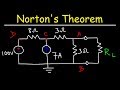
Nodal Analysis and Circuit Theorems

Interactive Video
•
Physics, Science
•
10th - 12th Grade
•
Practice Problem
•
Hard

Mia Campbell
FREE Resource
Read more
10 questions
Show all answers
1.
MULTIPLE CHOICE QUESTION
30 sec • 1 pt
What is the first step in applying Norton's Theorem to a circuit?
Identify all the resistors in the circuit.
Determine the equivalent voltage source.
Calculate the load current directly.
Calculate Norton's resistance.
2.
MULTIPLE CHOICE QUESTION
30 sec • 1 pt
How do you find the equivalent resistance when resistors are in series?
Multiply their resistances.
Add their resistances.
Divide their resistances.
Subtract their resistances.
3.
MULTIPLE CHOICE QUESTION
30 sec • 1 pt
What is the equivalent resistance of an 11 ohm and a 3 ohm resistor in parallel?
8 ohms
3.5 ohms
2.357 ohms
14 ohms
4.
MULTIPLE CHOICE QUESTION
30 sec • 1 pt
Which law is used to perform nodal analysis in the circuit?
Kirchhoff's Current Law
Norton's Law
Kirchhoff's Voltage Law
Ohm's Law
5.
MULTIPLE CHOICE QUESTION
30 sec • 1 pt
What is the potential at point C after solving the nodal analysis?
100 volts
66.857 volts
33.4285 volts
24 volts
6.
MULTIPLE CHOICE QUESTION
30 sec • 1 pt
How is the Thevenin voltage related to the potential at point A?
It is double the potential at point A.
It is half the potential at point A.
It is equal to the potential at point A.
It is unrelated to the potential at point A.
7.
MULTIPLE CHOICE QUESTION
30 sec • 1 pt
What is the formula for calculating Norton's current using Thevenin voltage?
Norton's resistance divided by Thevenin voltage
Thevenin voltage divided by load resistance
Load resistance divided by Thevenin voltage
Thevenin voltage divided by Norton's resistance
Access all questions and much more by creating a free account
Create resources
Host any resource
Get auto-graded reports

Continue with Google

Continue with Email

Continue with Classlink

Continue with Clever
or continue with

Microsoft
%20(1).png)
Apple

Others
Already have an account?

