
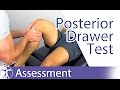
Assessing Knee Ligament Tests

Interactive Video
•
Science, Physical Ed, Health
•
9th - 12th Grade
•
Practice Problem
•
Hard

Ethan Morris
FREE Resource
Read more
6 questions
Show all answers
1.
MULTIPLE CHOICE QUESTION
30 sec • 1 pt
What is the primary purpose of the posterior drawer test?
To test for hip stability
To assess the anterior cruciate ligament
To evaluate the posterior cruciate ligament
To measure knee flexion
2.
MULTIPLE CHOICE QUESTION
30 sec • 1 pt
In what position should the patient be placed to perform the posterior drawer test?
Prone with knee extended
Standing with knee flexed
Supine with hip flexed to 45 degrees and knee flexed to 90 degrees
Sitting with legs extended
3.
MULTIPLE CHOICE QUESTION
30 sec • 1 pt
What indicates a positive result in the posterior drawer test?
The knee joint feels rigid
The tibia translates posteriorly more than six millimeters
The patient experiences pain in the hip
The tibia translates anteriorly more than six millimeters
4.
MULTIPLE CHOICE QUESTION
30 sec • 1 pt
What should you do to stabilize the patient's position during the test?
Hold the patient's knee with both hands
Sit slightly on the patient's foot
Ask the patient to hold their knee
Use a strap to secure the knee
5.
MULTIPLE CHOICE QUESTION
30 sec • 1 pt
Where can you find more information on assessing PCL tears?
In the medial section video
In the posterior section video
In the anterior section video
In the lateral section video
6.
MULTIPLE CHOICE QUESTION
30 sec • 1 pt
What is recommended if you want to learn about ACL tear assessment?
Check out the posterior drawer test video
Check out the anterior drawer test video
Check out the medial drawer test video
Check out the lateral drawer test video
Access all questions and much more by creating a free account
Create resources
Host any resource
Get auto-graded reports

Continue with Google

Continue with Email

Continue with Classlink

Continue with Clever
or continue with

Microsoft
%20(1).png)
Apple

Others
Already have an account?

