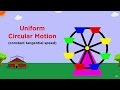
Understanding Uniform Circular Motion

Interactive Video
•
Physics, Science
•
9th - 12th Grade
•
Practice Problem
•
Medium

Sophia Harris
Used 23+ times
FREE Resource
Read more
10 questions
Show all answers
1.
MULTIPLE CHOICE QUESTION
30 sec • 1 pt
What distinguishes uniform circular motion from linear motion?
It involves motion along a circular path with varying speed.
It involves motion in a straight line with varying speed.
It involves constant speed in a straight line.
It involves motion along a circular path with constant speed.
2.
MULTIPLE CHOICE QUESTION
30 sec • 1 pt
What is tangential speed?
The speed of an object moving in a zigzag pattern.
The speed of an object at the center of the circle.
The speed of an object along the tangent to the circular path.
The speed of an object along a straight line.
3.
MULTIPLE CHOICE QUESTION
30 sec • 1 pt
How does the tangential speed of a car on a Ferris wheel change with distance from the center?
It becomes zero at the edge of the wheel.
It increases as the distance from the center increases.
It remains constant regardless of the distance.
It decreases as the distance from the center increases.
4.
MULTIPLE CHOICE QUESTION
30 sec • 1 pt
What causes centripetal acceleration in uniform circular motion?
A change in the magnitude of velocity.
A change in the shape of the path.
A change in the direction of velocity.
A change in the mass of the object.
5.
MULTIPLE CHOICE QUESTION
30 sec • 1 pt
How is centripetal acceleration calculated?
Tangential speed divided by the radius.
Tangential speed squared divided by the radius.
Radius squared divided by tangential speed.
Radius divided by tangential speed.
6.
MULTIPLE CHOICE QUESTION
30 sec • 1 pt
What is the relationship between centripetal force and centripetal acceleration?
Centripetal force is the difference between mass and centripetal acceleration.
Centripetal force is the quotient of mass and centripetal acceleration.
Centripetal force is the sum of mass and centripetal acceleration.
Centripetal force is the product of mass and centripetal acceleration.
7.
MULTIPLE CHOICE QUESTION
30 sec • 1 pt
What happens if the centripetal force acting on an object in circular motion is suddenly removed?
The object will continue in a circular path.
The object will move towards the center of the circle.
The object will stop moving immediately.
The object will move in a straight line tangent to the circle.
Access all questions and much more by creating a free account
Create resources
Host any resource
Get auto-graded reports

Continue with Google

Continue with Email

Continue with Classlink

Continue with Clever
or continue with

Microsoft
%20(1).png)
Apple

Others
Already have an account?
Popular Resources on Wayground

15 questions
Fractions on a Number Line

Quiz
•
3rd Grade
20 questions
Equivalent Fractions
Quiz
•
3rd Grade
25 questions
Multiplication Facts
Quiz
•
5th Grade
54 questions
Analyzing Line Graphs & Tables
Quiz
•
4th Grade
22 questions
fractions
Quiz
•
3rd Grade
20 questions
Main Idea and Details
Quiz
•
5th Grade
20 questions
Context Clues
Quiz
•
6th Grade
15 questions
Equivalent Fractions
Quiz
•
4th Grade
Discover more resources for Physics
27 questions
Simple Machines and Mechanical Advantage Quiz
Quiz
•
9th Grade
16 questions
Coulomb's Law
Quiz
•
11th Grade
10 questions
Understanding Heat, Thermal Energy, and Temperature
Interactive video
•
9th - 10th Grade
10 questions
Newton's Laws of Motion
Quiz
•
10th Grade
10 questions
unit 10 -- electric forces and fields

Lesson
•
9th - 12th Grade
21 questions
Diffraction, Reflection, Refraction
Quiz
•
9th - 12th Grade
15 questions
Position vs. Time and Velocity vs. Time Graphs
Quiz
•
10th - 12th Grade
10 questions
Types of Chemical Reactions
Quiz
•
10th Grade